
 sales@sunriver-electric.com
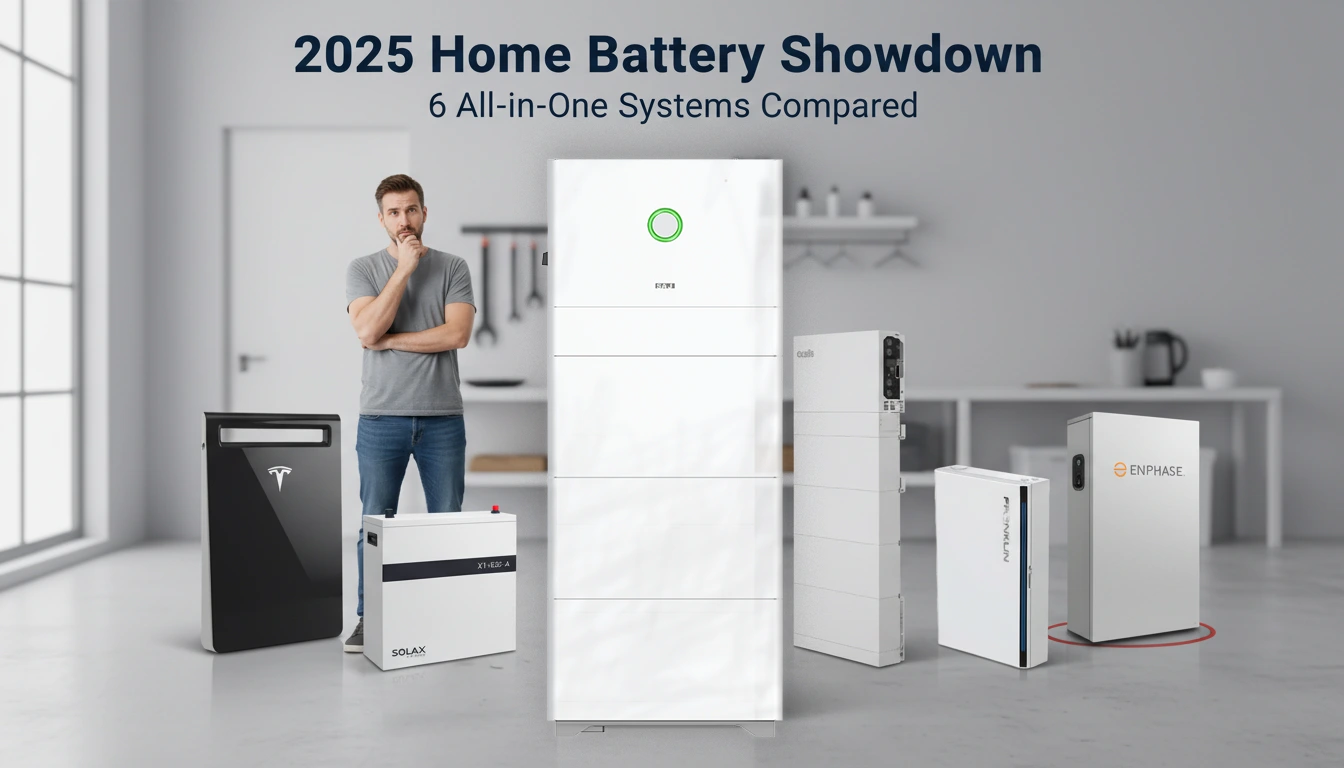
O residential battery storage market1 more than doubled in size from 2024 to 2025, with installations growing 132% year-over-year. If you’re considering adding battery storage to your home—whether for backup power, bill savings, or energy independence—all-in-one systems offer the simplest path forward.
These integrated units combine the battery, inverter, and smart controls in a single package, cutting installation time from weeks to days. But with six major systems competing for your investment, how do you choose? We evaluated them across performance, customization, capabilities, and warranty to help you find your match.
**Sunriver Electric is proud to be a Cooperative Authorized Supplier for the SAJ product line. The primary goal is to find the right solution for você.** Whether that’s an SAJ system or another brand that better fits your home and budget, we provide objective guidance based on your unique situation.
Why 2025 Is the Year for Home Battery Storage
Three forces are converging to make 2025 a turning point for home battery adoption: rising electricity costs, declining grid reliability2, and strong financial incentives.
These factors are creating a clear case for energy independence.
- Rising Costs: Electricity costs have climbed 10.5% since 2022, pushing the national average to $0.17 per kilowatt-hour (kWh). In states like California and Hawaii, rates can exceed $0.30/kWh during peak hours.
- Grid Reliability: Grid reliability continues to decline. U.S. homes now experience an average of 4.8 hours of total outage time annually, according to DOE reliability reports.
- Financial Incentives: O federal Investment Tax Credit3 remains at 30% through 2032, covering both solar panels and battery storage.
All-in-one systems amplify these advantages. Unlike component-based setups that require separate battery modules, inverters, and control systems (often taking 3-5 days to install), all-in-one units typically complete in 1-3 days with everything backed by a single manufacturer.
Think of it like buying a laptop versus building a desktop from parts: you trade some customization for simplicity, speed, and unified support.
With 6 manufacturers offering true all-in-one solutions (battery plus integrated inverter), the market has matured. You’re now choosing between strong options, not settling for limited ones. So how do you compare them? Our framework breaks it down.
How We Evaluated the Top 6 Systems
We evaluated all 6 systems using a 100-point scoring framework across 4 weighted criteria, with specifications verified from official manufacturer datasheets.
This framework balances the four factors that matter most to homeowners:
- Performance (35%): Measures capacity, peak and continuous power output, roundtrip efficiency4, and battery chemistry safety.
- Customization (25%): Evaluates modular expansion capability and scalability range—can you start small and grow, or are you locked into a fixed capacity?
- Capabilities (25%): Assesses smart features like AI-powered energy management, Virtual Power Plant (VPP) readiness5, EV charging integration, and DC solar coupling6.
- Warranty (15%): Considers the coverage period and, most importantly, the capacity retention guarantees7.
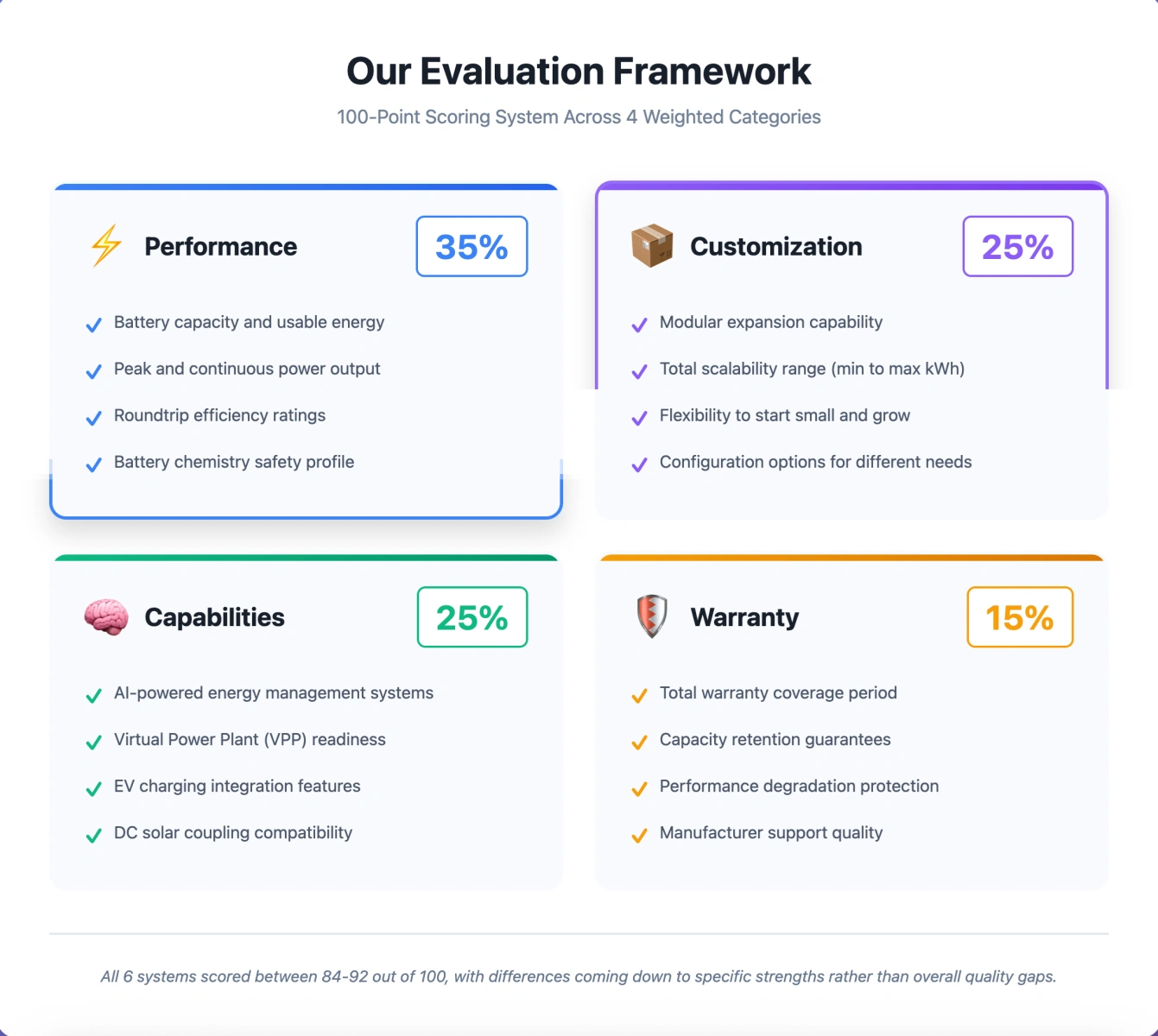
The result? Six systems scored between 84-92 out of 100, with differences coming down to specific strengths rather than overall quality gaps.
Read to learn more about SAJ systems:
- Análise do Sistema de Armazenamento de Energia HS3
- HS2 All-in-One Energy Storage System Review
- Comparação de sistemas de armazenamento de energia «tudo-em-um» – deeper feature and spec comparison across HS2, HS3, and CHS2
FAQ – Quick-Start Guide to Home Batteries
These are the three most common questions homeowners ask when starting their battery storage journey.
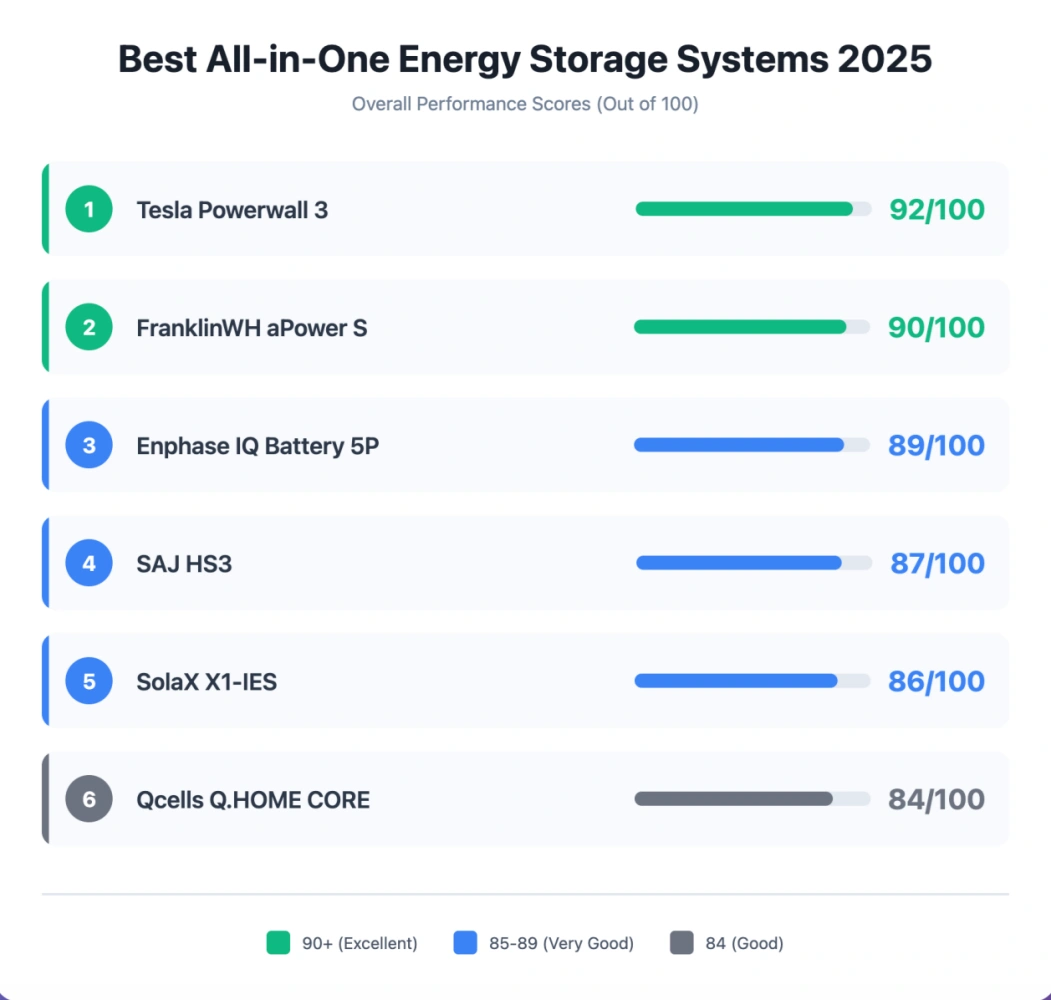
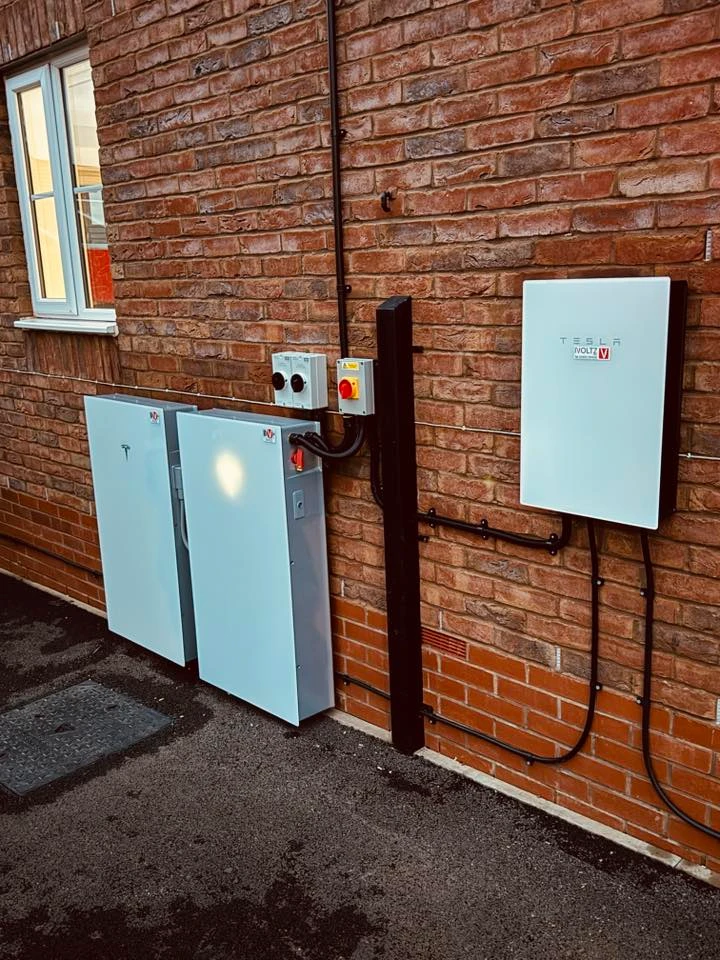
1 Tesla Powerwall 3 (Score: 92/100)
Best For: New solar+storage installations + High peak power
The Powerwall 3’s main advantage is its massive 30 kW of surge capacity. This is the feature that allows you to start multiple high-draw appliances at the same time—like a central AC, an electric stove, and an EV charger—without the system tripping or forcing you to manage your loads.
When paired with a new solar array, its integrated hybrid inverter also streamlines the entire installation. The Tesla app’s "Storm Watch" feature automatically pre-charges the battery before severe weather events, a useful feature in hurricane zones.
Key Specifications
| Especificações | Valor | Notas |
|---|---|---|
| Capacity | 13.5 kWh, expandable to 54 kWh | 4-unit maximum configuration |
| Potência de pico | 30 kW (10 seconds), 10 kW continuous | Industry-leading surge capacity |
| Eficiência | 97.5% roundtrip | Maintained per user specifications |
| Química | LFP (>500°C thermal stability8) | Fire-resistant, long cycle life |
| Coupling | DC-only (NO AC coupling) | CRITICAL: Cannot retrofit to existing solar |
| Garantia | 10 years, 70% retention | Standard industry warranty. |
| Pricing | $900-1,100/kWh | $12,000-13,500 for 13.5 kWh pre-ITC |
Unique Differentiators
That 30 kW peak power—the highest in this comparison—means you avoid the "which appliance starts first?" choreography during power outages.
Seamless Tesla ecosystem integration connects battery monitoring with solar production tracking. For Tesla vehicle owners, it also shows EV charging status in a single app. The 20 kW DC solar input capacity9 supports large solar arrays (6-8 kW typical) without external equipment.
Things to consider about the Powerwall 3
- CRITICAL: DC-Only Architecture: The Powerwall 3 does NOT support AC coupling. This means it cannot be added to existing solar systems unless you replace your solar inverter, a $3,000-$8,000 additional cost.
- Best for New Installs: This system should only be chosen if you’re installing new solar and storage at the same time. This is the only way to maximize its 4-8% DC-coupling efficiency advantage.
- Service Times: Reported service response times can run 2-4 weeks in some regions, compared to 3-7 days for some local installers of other brands.
- Fixed Capacity: Unlike modular systems, the 13.5 kWh capacity is fixed per unit. You can’t expand a single Powerwall; you must add 2-4 separate units to reach 27-54 kWh total capacity.
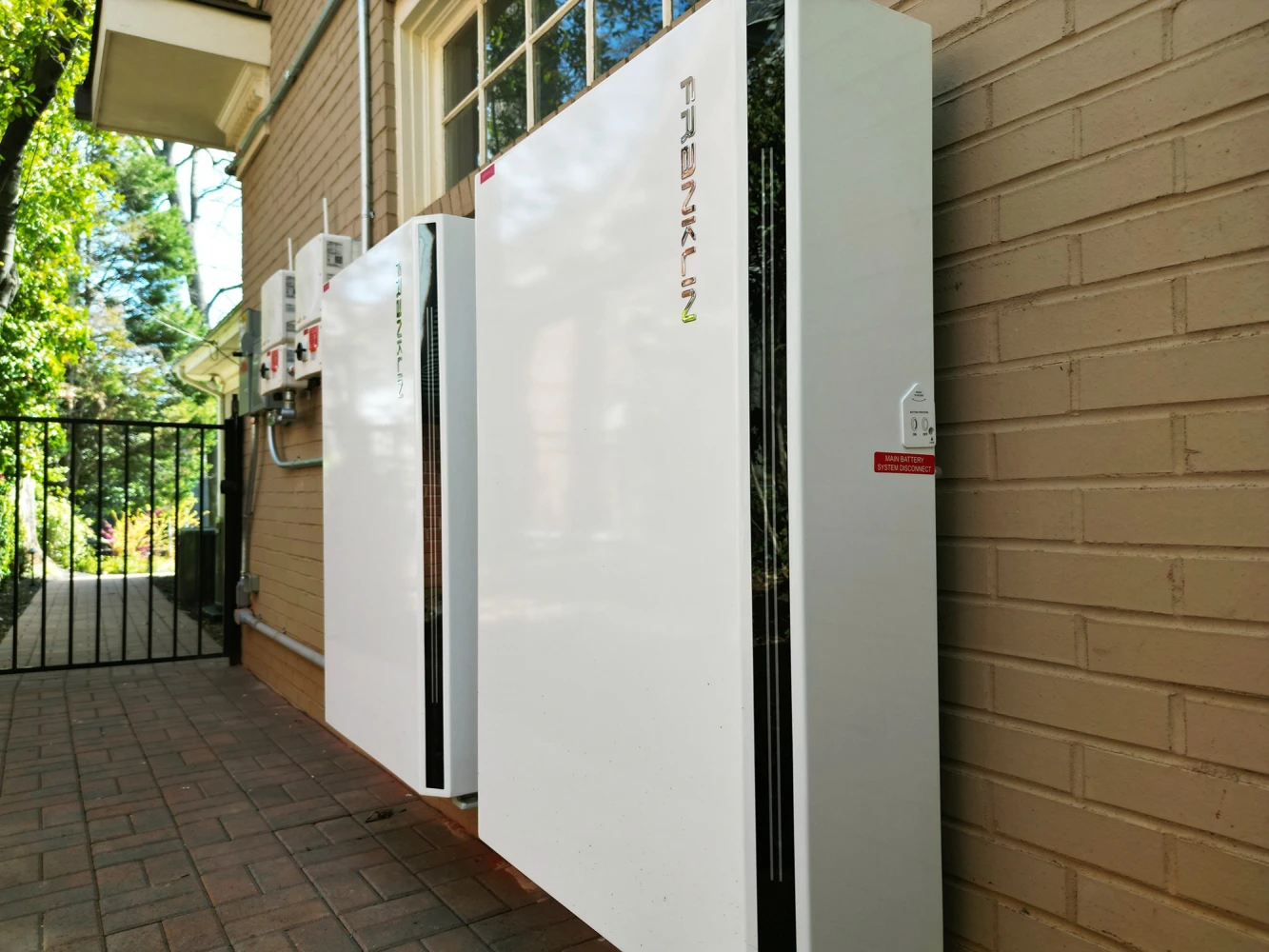
2 FranklinWH aPower S (Score: 90/100)
Best For: Whole-home backup + Generator integration
For homeowners in areas with multi-day outages, FranklinWH’s seamless generator integration solves the "what if the battery runs dry?" problem, offering true long-term energy security.
This system’s 15 kWh capacity delivers 11% more storage than a single Powerwall 3. Its real strength is the aGate controller10, which automatically coordinates power from your solar, battery, the grid, and a backup generator.
This smart coordination runs your generator at its peak efficiency (not constant idling) to recharge the battery, which can provide 30-50% fuel savings compared to a simple manual transfer switch.
Key Specifications
| Especificações | Valor | Notas |
|---|---|---|
| Capacity | 15 kWh, expandable to 225 kWh | 15-unit maximum requires verification |
| Potência de pico | 15 kW (10 seconds) | Original 25 kW claim not found in datasheet |
| Potência contínua | 10 kW (battery), 11.5 kW (PV+battery) | Verified from official specs |
| Eficiência | 90.5% roundtrip | Lower than 95-97% competitors |
| Química | LFP (>500°C thermal stability8) | Fire-resistant safe analogy applies |
| Garantia | 12 years, 70% retention | 20% longer than 10-year standard |
| Pricing | $800-1,000/kWh installed | Based on 2025 installer quotes |
Unique Differentiators
O aGate controller3 is the brain, handling complex multi-source power management automatically. It decides when to draw from solar, battery, grid, or generator based on availability and cost.
The 12-year warranty provides 2 additional years of coverage beyond the 10-year industry standard. And with 4x 15A MPPTs supporting 20 kW of DC solar input, you can connect large solar arrays without external combiner boxes.
Things to consider about the aPower S
- Lower Efficiency: The 90.5% roundtrip efficiency11 means for every 10 kWh you store, 9.05 kWh is available. This costs roughly $52 annually (at $0.15/kWh, 10kWh/day cycle) compared to $27/year for 95% systems. This is an acceptable trade-off if generator integration is your priority.
- Smaller Installer Network: FranklinWH’s installer network is smaller than Tesla’s or Enphase’s, which may affect service response times in some regions.
- Lower Peak Power: While 15 kW peak power handles most simultaneous loads, it’s half of Tesla’s 30 kW surge capacity. You might need to sequence the startup of central AC, an electric stove, and a dryer.
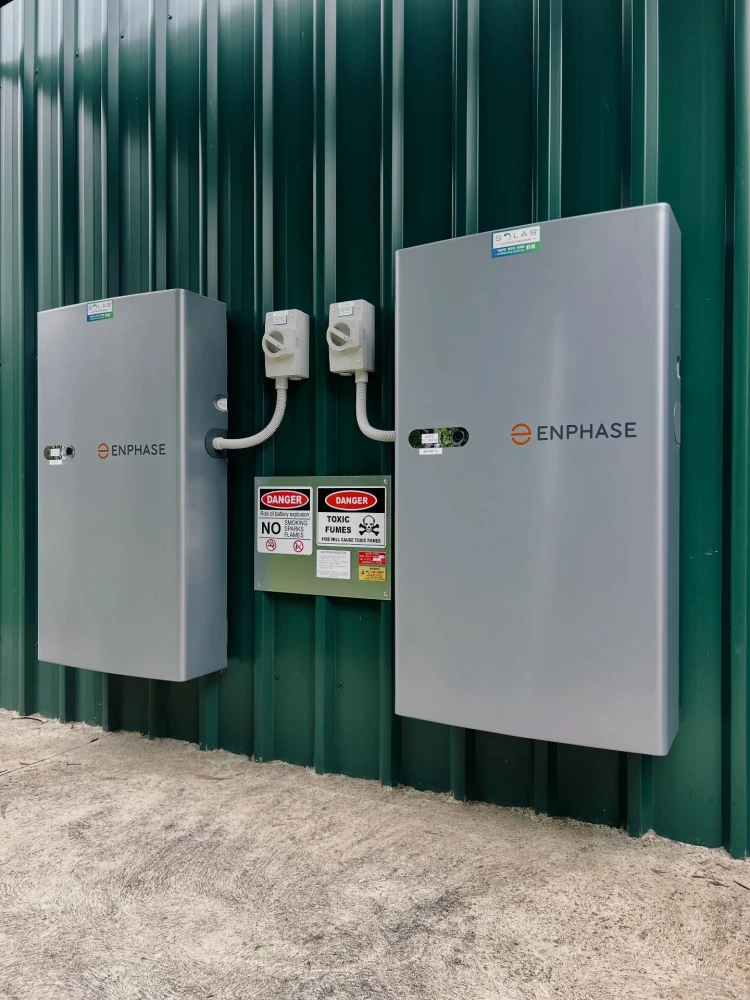
3 Enphase IQ Battery 5P (Score: 89/100)
Best For: Highest modularity + Microinverter compatibility
If you already have Enphase microinverters, the IQ Battery 5P is the seamless choice. Its modular 5 kWh units let you start small and expand your capacity over time, all within the app you already use.
This system offers the most flexible expansion path in this comparison. You can start with one 5 kWh battery (around $4,750 post-ITC) and scale up to 80 kWh (16 units) as your budget and needs grow.
The 15-year warranty tops our comparison by 25-50%. If the 1,800-strong Enphase-certified installer network holds true, it also suggests broader geographic coverage and potentially faster service than competitors.
Key Specifications
| Especificações | Valor | Notas |
|---|---|---|
| Capacity | 5-80 kWh (16 units max) | Corrected from originally claimed 100 kWh |
| Potência de pico | 7.68 kW per unit (scalable) | Multiply by number of units installed |
| Potência contínua | 3.84 kW per unit (scalable) | Multiply by number of units installed |
| Eficiência | 96% DC-coupled / 90% AC-coupled | Different ratings for new vs. retrofit solar |
| Química | LFP | Standard fire-resistant chemistry |
| Garantia | 15 years, 80% retention | Retention percentage requires verification |
| Pricing | $950/kWh, $4,750 single unit post-ITC | Based on 2025 installer data |
Unique Differentiators
The 5-80 kWh scalability in 5 kWh increments is the most flexible option available. For existing Enphase microinverter owners, battery and solar monitoring are consolidated in the single Enlighten app instead of juggling separate platforms.
Things to consider about the IQ 5P
- AC-Coupled Efficiency: When retrofitting to an existing system, the AC-coupled efficiency is 90%. This 6-10% energy loss per cycle (vs. DC) translates to roughly $55/year for 10 kWh daily cycling at $0.15/kWh.
- Cost at Scale: Multi-unit installations cost more than single large-capacity competitors. Getting 15 kWh (3 units) would be around $14,250, versus a single 15 kWh FranklinWH system at $9,000-$15,000.
- Third-Party Solar: If you use this battery with non-Enphase solar systems, you may experience reduced monitoring integration and need separate apps for solar versus battery management.
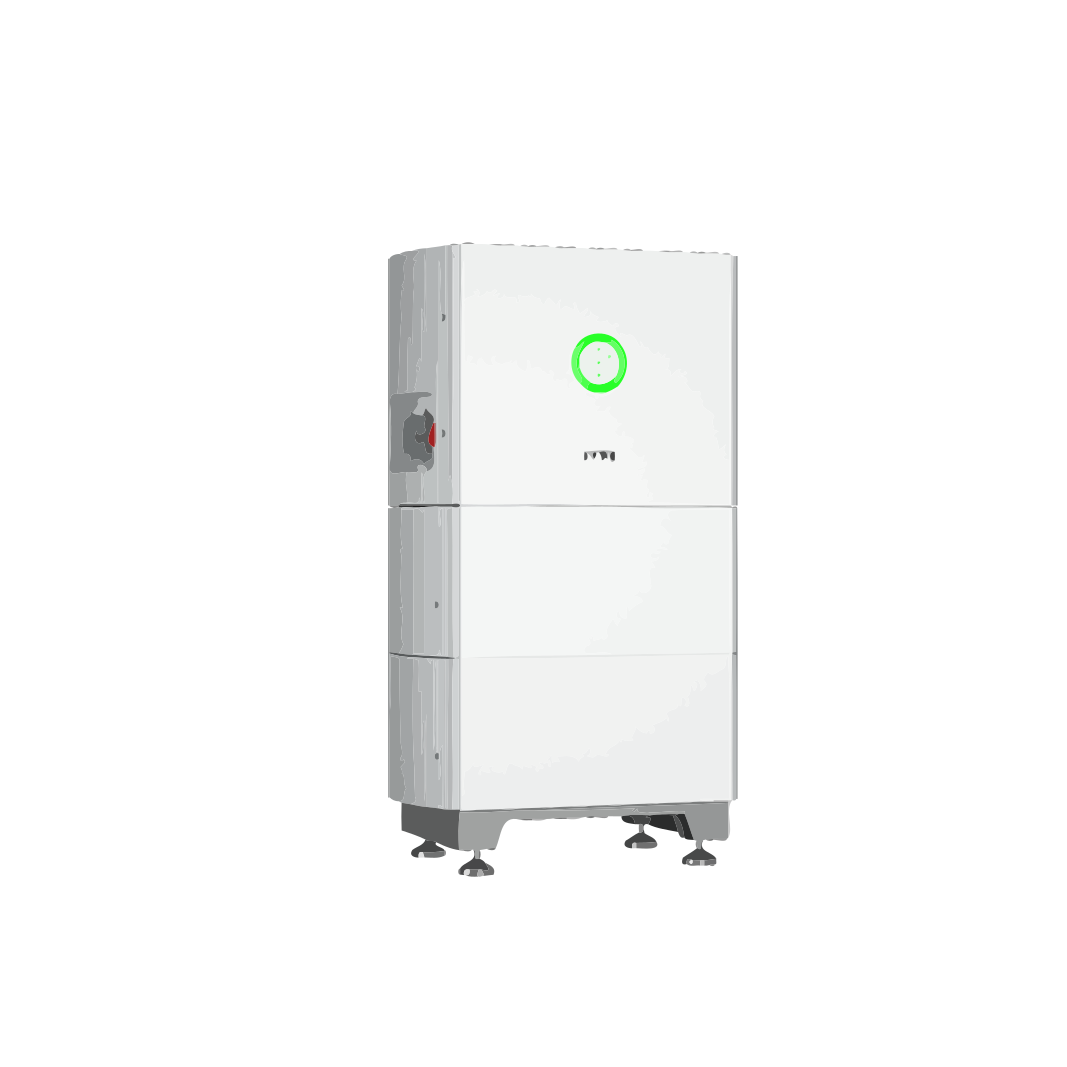
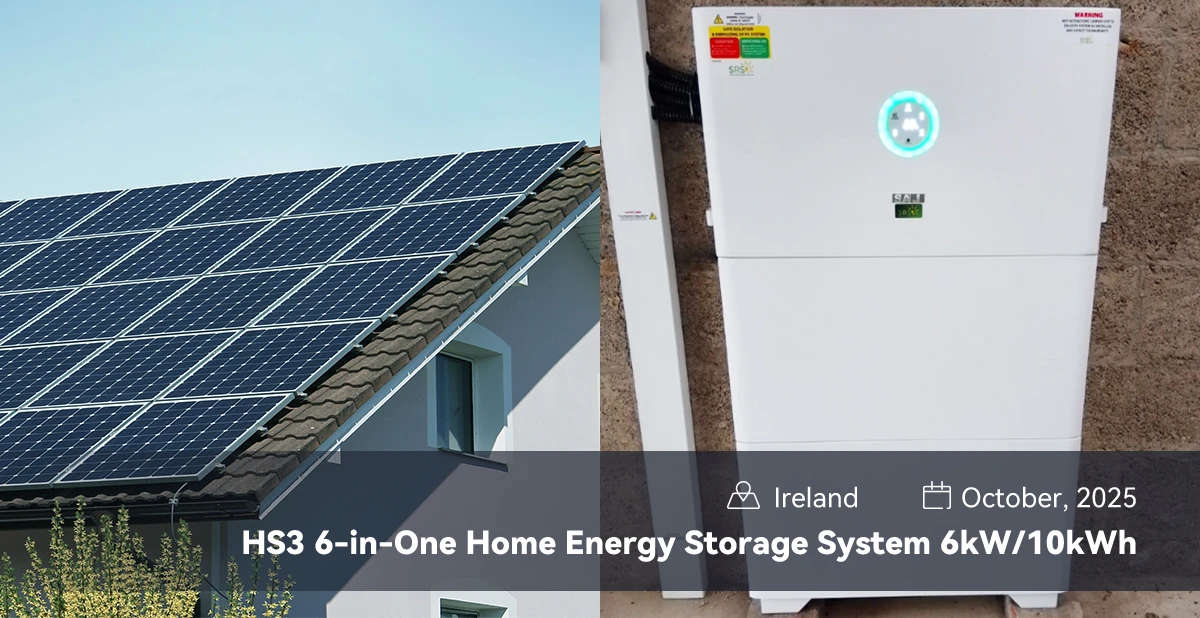
4 SAJ HS3 (Score: 87/100)
Best For: Integrated EV charger + AI-powered energy management12
If you plan to add an electric vehicle, the SAJ HS3’s integrated 7 kW Level 2 EV charger can save you $700-$900. This combination of smart features, reliable performance, and strong value is why we at Sunriver Electric are a proud Cooperative Authorized Supplier for the SAJ brand.
O Elekeeper AI-EMS13 coordinates all your home energy. It learns your utility’s Time-of-Use (TOU) rate patterns14 to optimize when to charge the home battery, when to charge your vehicle, and when to discharge stored energy during peak price periods.
Key Specifications
| Especificações | Valor | Notas |
|---|---|---|
| Capacity | 10-40 kWh modular | 4-module maximum requires verification |
| Potência de pico | 9 kW | Corrected from originally stated 10 kW |
| Potência contínua | 7 kW | Verified from official specifications |
| Eficiência | 94-96% roundtrip | Corrected from claimed 97% |
| Química | LFP | Standard fire-resistant chemistry |
| Garantia | 10 years, 70% retention | Standard industry warranty terms |
| Pricing | $600/kWh | Requires 2025 installer quote validation |
Unique Differentiators
The integrated 7 kW EV charger is the standout feature. From our experience as a supplier, we know this consolidation is a key advantage, saving homeowners not just the $700-$900 in hardware, but also significant project coordination and complexity.
If the $600/kWh pricing holds, that’s 25-40% less than mid-range competitors. The 10 kWh module size also strikes a good balance for scaling, fitting between FranklinWH’s 15 kWh and Enphase’s 5 kWh increments.
Things to consider about the HS3
- VPP Readiness15: Original VPP-ready claims were not verified in official documentation. Unlike Tesla or Enphase, you may not be able to earn $200-500/year from grid services programs.
- Installer Network: SAJ has a smaller U.S. installer network compared to Tesla or Enphase, which can affect availability, service times, and pricing consistency.
- Shorter Warranty: The 10-year warranty is shorter than FranklinWH’s (12 years) or Enphase’s (15 years).
- Lower Peak Power: At 9 kW, the peak power is 40% lower than FranklinWH’s (15 kW) and 70% lower than Tesla’s (30 kW). You will likely need to manage loads if starting multiple high-power appliances at once.
SAJ HS2 vs. HS3 Quick Comparison
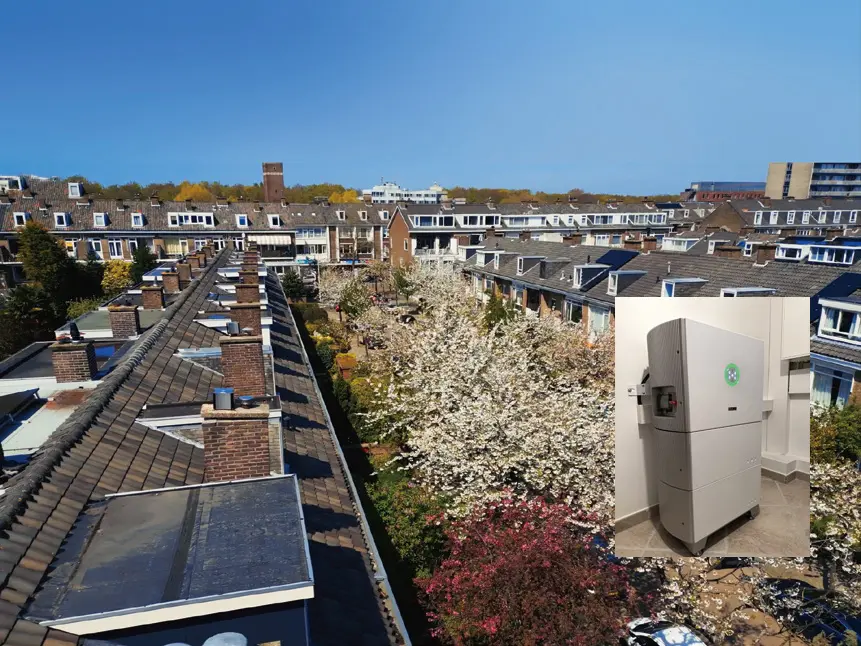
If you’re comparing SAJ’s product line, here is the quick breakdown. The HS3 (this review) is built for larger capacity and EV integration, while the HS2 is a more compact, high-efficiency alternative.
| Característica | SAJ HS2 | SAJ HS3 (This Review) |
|---|---|---|
| Form Factor | Floor-mounted tower | Wall or floor mount |
| Capacity | 5-30 kWh (in 5 kWh steps) | 10-40 kWh (in 10 kWh steps) |
| Eficiência | 95-98% range | 94-96% range |
| EV Charger | Não | Yes (Integrated 7 kW) |
| Ideal para | Space-efficiency, high efficiency | EV charging, larger capacity |
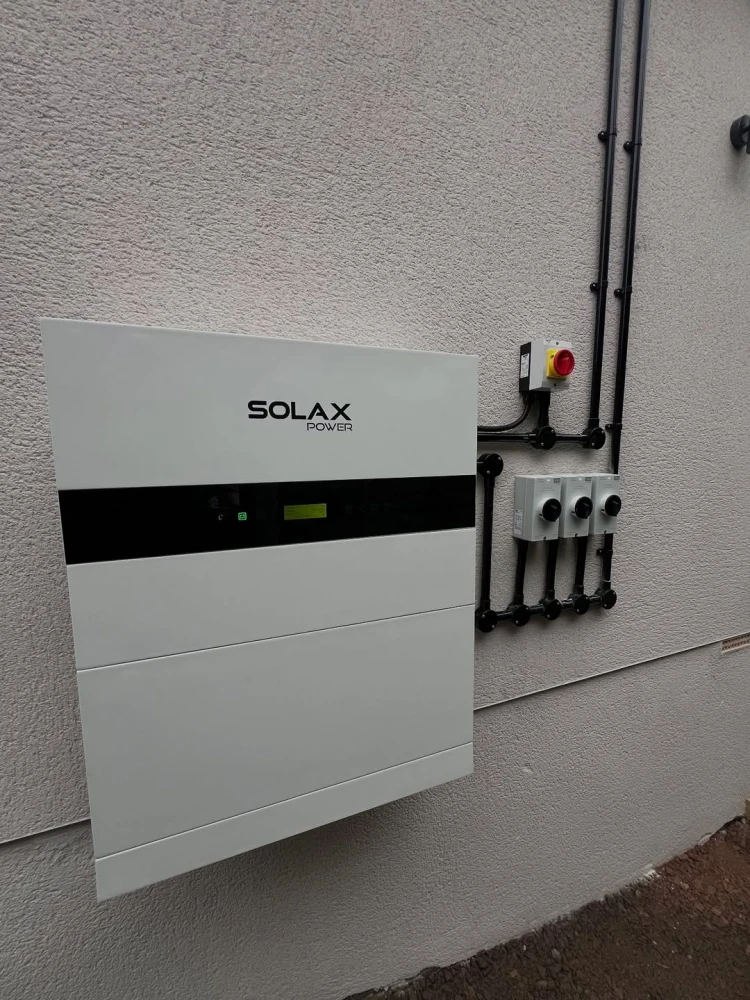
5 SolaX X1-IES (Score: 86/100)
Best For: Budget-conscious + AI-ready features
For homeowners on a tight budget who still want future-proof features, the SolaX X1-IES offers AI-ready hardware for Time-of-Use (TOU) optimization at a potential entry-level price point.
This system allows you to start small with a 5 kWh unit (potentially $2,000-$3,500 post-ITC if pricing holds) and expand to 20 kWh as your budget or needs grow.
Its AI-ready architecture includes TOU learning algorithms to optimize charge and discharge schedules based on your utility’s rate patterns, though you should verify with your installer if these features are fully functional or planned for future updates.
Key Specifications
| Especificações | Valor | Notas |
|---|---|---|
| Capacity | 5-20 kWh modular | Maximum 20 kWh confirmed; no 40 kWh option |
| Potência de pico | Model-specific (3.0-6.0 kW) | No universal "2× inverter" formula applies |
| Potência contínua | Varies by inverter (2.5-8 kW) | Depends on integrated hybrid inverter model |
| Eficiência | 95-97% roundtrip | Lower bound corrected from 96% |
| Química | LFP | Standard fire-resistant chemistry |
| Garantia | 10 years, 80% retention | Verified from warranty documentation |
| Pricing | $400-700/kWh | Requires 2025 installer quote validation |
Unique Differentiators
If the $400-700/kWh pricing holds, SolaX is positioned as the budget leader, potentially 25-40% less than mid-range competitors. The 5 kWh expansion increments also let you match capacity additions to your budget more precisely than 10-15 kWh modules.
Things to consider about the X1-IES
- Low Max Capacity: The 20 kWh maximum capacity may fall short for whole-home backup or substantial EV charging, compared to Enphase’s 80 kWh or FranklinWH’s 225 kWh.
- Variable Power: Peak power specifications vary by the inverter model (3.0 kW to 6.0 kW). You must verify your specific model’s surge capacity; there’s no universal calculation.
- Limited U.S. Presence: SolaX has a limited U.S. market presence. You will need to secure multiple 2025 quotes to get accurate local pricing and assess installer availability in your region.
6 Qcells Q.HOME CORE (Score: 84/100)
Best For: High capacity single unit + German engineering quality
If you want a high-capacity 18 kWh system in a single fixed unit and value a reputation for German engineering quality, the Qcells Q.HOME CORE is a simple, non-modular solution.
This system’s D20.0SX model delivers 33% more capacity than a single Tesla Powerwall 3 (13.5 kWh) at a comparable $950/kWh price.
Having 18 kWh in one installation means fewer units, simpler permitting, and potentially lower installation labor compared to multi-unit systems trying to reach a similar capacity.

Key Specifications
| Especificações | Valor | Notas |
|---|---|---|
| Capacity | 18 kWh fixed | Corrected from "18-20 kWh range" |
| Potência de pico | 11.1 kW | Corrected from 12 kW; "highest" false claim deleted |
| Potência contínua | 7.6 kW | Corrected from 9.6 kW (2.0 kW overestimation) |
| Eficiência | 95% roundtrip | Corrected from claimed 96.5% |
| Química | LFP | Standard fire-resistant chemistry |
| Garantia | 10 years, 70% retention | Standard industry warranty terms |
| Pricing | $950/kWh (~$17,100 for 18 kWh) | Based on 2025 market data |
Unique Differentiators
Its fixed 18 kWh capacity is the highest among the non-modular systems in this review, providing 33% more than Tesla and 20% more than FranklinWH in a single box. It also supports DC-coupling for a 4-8% efficiency gain with new solar.
Things to consider about the Q.HOME CORE
- Load Management is Required: The 7.6 kW continuous limit is critical. You can run central AC (4,000W) + fridge (150W) + lights (300W) + microwave (1,000W) for a 5,650W total. You cannot run all those e an electric stove or dryer at the same time.
- Lower Peak Power: The 11.1 kW peak power is significantly lower than Tesla’s (30 kW) or FranklinWH’s (15 kW). You will need to sequence the startup of major appliances.
- Fixed Capacity: This is not a modular system. Unlike Enphase or SAJ, you are locked into 18 kWh with no path for future expansion.
FAQ – Power, Chemistry, and Efficiency
Understanding the technical numbers is key to avoiding a system that is undersized for your power needs or unsuited for your climate.
FAQ – How Battery Works in a Real Outage
These answers help you set realistic expectations for how a battery performs during an actual power outage.
Next Steps to Energy Independence
The residential battery market is growing at over 100% year-over-year. This has created strong, mature options for 2025 buyers, but it’s also critical to get sizing and compatibility right.
Remember the corrected sizing guidance: 6-10 kWh covers essential loads, but 25-40 kWh is a more realistic range for true whole-home backup (not 13-20 kWh as some sources suggest).
Also, remember that the Tesla Powerwall 3’s DC-only limitation is a non-starter for the 40-50% of buyers who already have solar. Finally, don’t confuse $/kW VPP revenue (like in MA) with $/kWh capacity rebates (like in CA).
Sunriver Electric helps you understand complex specifications, coordinate professional installation, and maximize available incentives. Ready to explore which system fits your home? Request a free consultation to review your electricity usage patterns, outage risk profile, and budget.
-
Understand the market expansion and investment opportunities in home energy storage systems for your decision-making. ↩
-
Understand the increasing outage risks and how battery backup protects your home from power disruptions. ↩
-
Learn how the 30% tax credit through 2032 can significantly reduce your battery storage installation costs. ↩ ↩
-
Learn how this key performance metric affects your energy savings and overall system effectiveness. ↩
-
Explore how VPP-ready systems can earn you money by supporting grid stability during peak demand. ↩
-
Understand this advanced feature that maximizes energy transfer directly from solar panels to storage. ↩
-
Learn how warranty coverage protects your investment by guaranteeing long-term battery performance. ↩
-
High thermal stability indicates fire-resistant chemistry that maintains safety even under extreme conditions or manufacturing defects. ↩ ↩
-
Higher DC input capacity supports larger solar arrays without external equipment, reducing installation complexity and costs. ↩
-
Discover how smart power coordination can reduce generator fuel consumption by 30-50% compared to manual transfer switches. ↩
-
Roundtrip efficiency directly impacts your long-term operating costs; learn how small percentage differences translate to significant annual savings. ↩
-
Discover how artificial intelligence learns your utility rates to maximize savings on electricity costs. ↩
-
Understand this advanced energy management system that coordinates battery, EV, and home power automatically. ↩
-
Learn strategies to shift energy usage to cheaper hours and reduce your monthly electricity bills significantly. ↩
-
Find out how grid services programs can generate $200-500 annually from your home battery system. ↩