

 sales@sunriver-electric.com

If you’re looking into solar power, you’ll hear about "MPPT" a lot. It sounds a bit techy, but it’s super important. It helps get the most energy from your solar panels.
Think of it like a smart helper in your solar inverter. It works hard so you save more money.
So, why is MPPT such a big deal? Let’s look at it in simple terms. We’ll see why it’s a must-have for good solar power setups today.
MPPT: The Core Concept
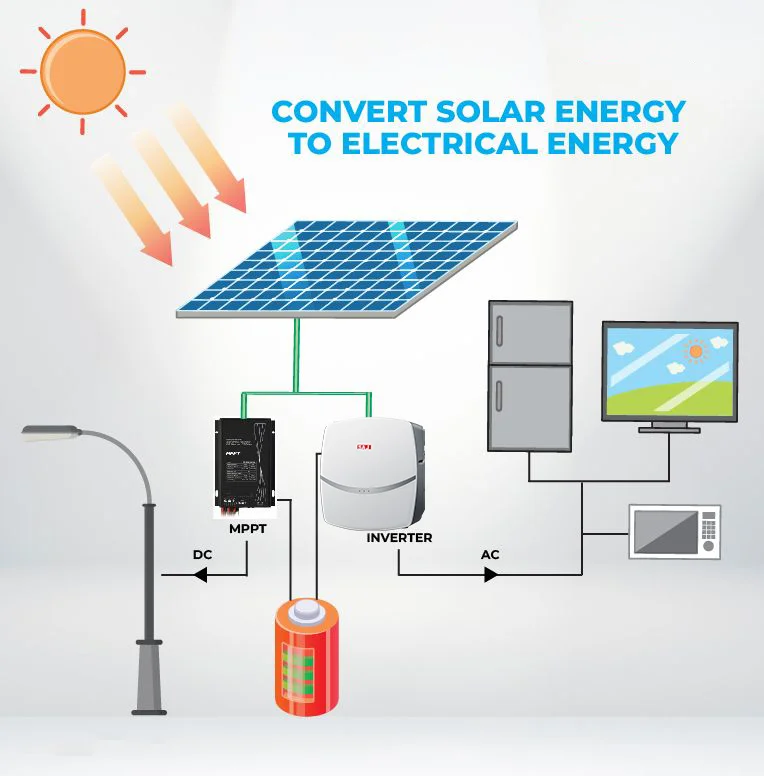
Maximum Power Point Tracking, or MPPT, is a critical technology inside every modern solar inverter. Before diving into advanced topics, it’s essential to understand this foundational principle.
1. What It Is: A Simple Definition
At its heart, MPPT is a smart electronic controller. Its primary function is to continuously adjust the electrical operating point of the solar panels.
In essence, it acts as an optimizer, constantly forcing the panels to produce the maximum amount of power they are capable of at any given moment.
This "maximum power point" is not a fixed value; it’s a moving target.
2. Why It’s Necessary: The Challenge of a Changing Environment
The need for MPPT arises from a simple fact: a solar panel’s performance is constantly affected by its environment. The two main variables are:
- Sunlight Intensity: From the bright sun of noon to the scattered light of a cloudy day.
- Panel Temperature: From a cool morning to a hot afternoon.
Without MPPT, a system would be "stuck" at a suboptimal operating point, wasting significant amounts of potential energy as these conditions change.
3. The Impact: A Leap in Performance
The introduction of MPPT was not a minor improvement; it was a revolutionary step forward for solar energy efficiency.
- For Overall Energy Harvest: An MPPT-equipped system can generate up to 30% more energy than a system without it, especially in variable weather.
- For Financial Viability: On large commercial projects (>100 kW), even a 0.5% gain in tracking efficiency can translate to over €700 in extra revenue per year, often justifying the cost of maintenance visits.
Understanding this core principle—that MPPT is a dynamic optimizer designed to solve the problem of a constantly changing environment—is the key to appreciating the more advanced strategies, algorithms, and real-world applications we will explore in the following sections.
How MPPT Works: Finding the Panel’s "Sweet Spot"
So, how does MPPT find this "sweet spot" for power? It’s not magic, but it’s very clever. Most MPPTs use a smart plan. A common one is called "Perturb and Observe1" (P&O).
MPPT works by making small, quick changes to the solar panel’s voltage. It watches the power output and keeps adjusting to always get the most energy.
Here’s a simple way to think about it:
- The MPPT makes a tiny change to the panel’s working voltage.
- It then "observes" if the power output went up or down.
- If power went up, it keeps making changes in that direction.
- If power went down, it knows it went too far. So, it changes back the other way.
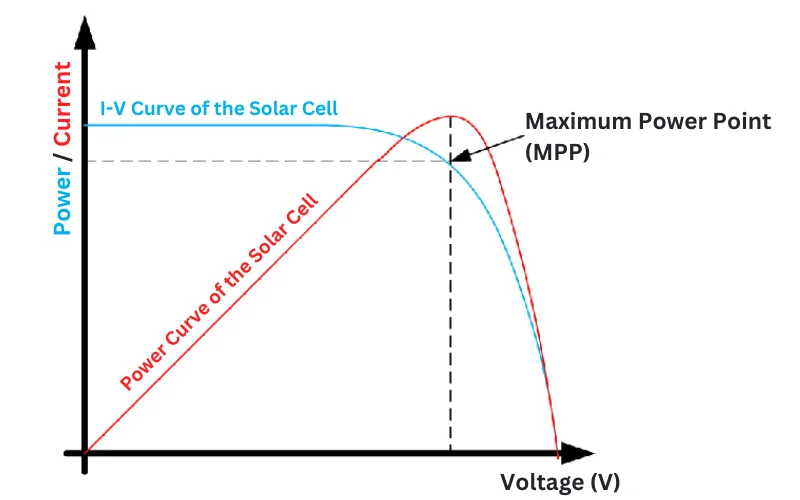
This happens very fast. It might check every 10 to 100 milliseconds. It’s always checking the panel’s I-V curve. The MPPT looks for the spot where power (Voltage times Current) is the highest.
This constant checking means the inverter reacts fast to changes in sun or panel heat. The panels always work their best.
Consider projects where clouds move really fast. When that happens, power levels can jump up or down quickly (like over 800 Watts per minute). In these cases, the newer MPPTs are much better. They can find the best power spot about three times faster than older P&O types.
This quickness stops about 2-3% of power loss2. This loss can happen when things change fast. For big panels, like 700W ones often used with SAJ R6 inverters, this adds up. It means a lot more energy over time.
Why MPPT Matters More Than Older Tech? The Core Differences Between MPPT & PWM
Core Technology Comparison
To understand this better, let’s imagine your solar panel is an employee and the charge controller is their manager.
-
MPPT: The Smart Project Manager
An MPPT controller acts like a smart project manager. It continuously monitors the employee’s (solar panel’s) optimal working state under varying weather and temperature conditions. It then dynamically adjusts the tasks (voltage) to ensure the employee is always delivering 100% efficiency (maximum power output). Finally, it efficiently converts this output into the format required by the team (the battery or grid).- Key Advantage: Almost no energy is wasted. Efficiency is typically boosted by 10%-30%.
-
PWM: The Simple Switch Operator
In contrast, a PWM controller is more like a simple switch operator. It doesn’t try to find the employee’s optimal state. Instead, it controls the work rhythm by rapidly "connecting" and "disconnecting" the circuit (making the employee work for a bit, then rest for a bit). While this method gets the job done (charges the battery), the employee is not operating at peak efficiency most of the time.- Key Disadvantage: Significant energy loss occurs when the solar panel’s voltage doesn’t perfectly match the battery’s voltage.
Conclusion: How to Choose?
| Característica | MPPT (Maximum Power Point Tracking) | PWM (Pulse Width Modulation) |
|---|---|---|
| Technology | Smart tracking, dynamic voltage adjustment | Simple switching, direct connection |
| Energy Efficiency | High (Typically a 10%-30% boost) | Lower |
| Best For | Medium-to-large, high-voltage systems | Small, low-power, budget-constrained systems |
| Cost | Higher | Economical |
In a Nutshell: If you are aiming for higher power efficiency and long-term returns, MPPT is the superior choice. If your system is very small and your budget is extremely limited, PWM can meet basic needs.
Different MPPT Algorithms Explained
"MPPT" is a fancy term for getting the most power out of a solar panel. But not all MPPT controllers think the same way. The controller has a "brain" inside, which is its method for finding that sweet spot of maximum power. This brain decides how well it works, especially when the weather isn’t perfect.
Let’s look at the three most common types of brains.
A Simple Look at MPPT Brains
| Brain Type | How It Thinks (Simplified) | Good For | The Downside |
|---|---|---|---|
| Perturb & Observe (P&O) | It uses "trial and error." It makes a small change and asks, "Did the power go up?" If yes, it keeps going. If no, it goes back. It’s the simplest way. | Clear, sunny days where the light is steady. This is the most common and cheapest type. | When clouds move fast, it can get confused. It also tends to bounce around the perfect power spot instead of staying right on it, which wastes a tiny bit of power. |
| Incremental Conductance (IncCond) | This one is smarter and uses math. It looks at how voltage and current are changing to predict the right direction to the best power spot without guessing. | Days with fast-moving clouds. It’s much quicker and more accurate than P&O when sunlight changes a lot. | It needs a slightly more powerful computer chip to do the math, which makes the controller a little more expensive. |
| Voltage Sweep / Shading Scan | This is the "find everything" method. Every so often, it stops and does a quick check of all the possible power spots on the panel from top to bottom. | A must-have for panels that get shade from trees, buildings, or even other panels. Shade can create fake "best spots," and this is the only way to find the real one. | To do the scan, it has to pause making power for a second. But the extra energy it finds in shady conditions makes this short pause totally worth it. |
Conclusion: Which Brain is Right for You?
-
If your panels are almost always in direct, full sun, a standard controller with a P&O brain is a great, affordable choice.
-
If your panels often get shade from trees, or you live where clouds move by quickly, you should get a controller with IncCond or a Shading Scan brain. It will cost a little more upfront, but you’ll get much more power in the long run.
MPPT’s Top 3 Myths: Don’t Let Bad Info Cost You Energy
MPPT technology is smart, but a lot of misinformation floats around. Believing these myths can lead to poorly designed systems that produce less power. Let’s clear up the three biggest myths to help you get the most from your solar investment.
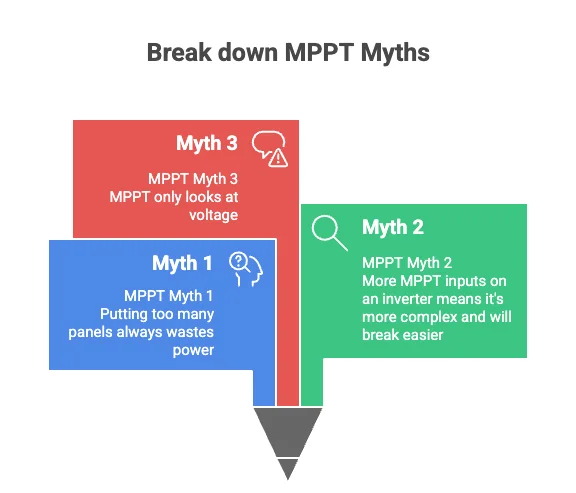
Myth 1: "Adding too many solar panels (DC oversizing) is always a waste of power."
The Reality: Smart oversizing often produces more energy over the year and can save you money.
It’s true that on a few perfectly sunny days, your inverter might not be able to handle 100% of the power from your panels. This is called "clipping." But here’s the bigger picture:
- More Power on Bad Days: Those "extra" panels help your system wake up earlier in the morning, work later in the evening, and produce significantly more power on cloudy or overcast days.
- Year-Round Gains: For most people, the energy gained on all those less-than-perfect days is much greater than the small amount lost to clipping on a few ideal days.
- It Saves Money: Often, it’s cheaper to add a few more panels than to upgrade to a bigger, more expensive inverter. This can help your project pay for itself faster.
Myth 2: "More MPPT inputs on an inverter just adds complexity and more things that can break."
The Reality: Multiple MPPTs make a system stronger and more efficient, especially on complex roofs.
Think of it this way:
- Separate Team Managers: An inverter with two MPPTs is like having two separate managers for two different teams of panels.
- Problems Stay Contained: If one team has a problem (like a panel gets covered in shade), it doesn’t slow down the other team. The healthy team keeps working at 100% speed.
- Better Panel Health: By isolating panel groups, multiple MPPTs can prevent issues like "hot spots" from damaging your panels over time. It’s a feature that adds resilience, not weakness.
Myth 3: "MPPT only needs to look at voltage to do its job."
The Reality: A truly smart MPPT acts like a detective, looking at multiple clues to find the real power sweet spot.
Voltage is an important clue, but it’s not the whole story.
- More Than One Clue: A good MPPT is constantly watching not just voltage, but also current (the flow of energy), panel temperature, and sunlight intensity.
- Finding the Real Sweet Spot: The perfect power point is a combination of all these factors. Looking at voltage alone is like a detective listening to only one witness—they might miss the truth. By looking at the big picture, the MPPT can find the actual best power spot, even when conditions are changing fast.
Unlocking More Power: How Multi-MPPT Inverters Conquer Tricky Roofs
Most roofs aren’t simple, flat rectangles perfectly facing the sun. They often have sections that face different directions (like east and west), or get shade from trees and chimneys. For these "tricky" roofs, the type of inverter you choose is critical.
The Problem: One "Brain" for a Whole Team
Imagine all your solar panels are one big team with only one coach. If a single player on the team trips (gets covered by shade), the entire team has to slow down to match that one player’s speed.
This is what happens with a single-MPPT inverter. All your panels are locked together and forced to work at the same, single power level. Any problem on one panel drags down the performance of the entire system.
The Solution: A "Brain" for Each Small Group
Now, imagine each group of panels on your roof has its own dedicated coach. This is what a multi-MPPT inverter does. It gives each section of your roof its own independent "brain."
- The panels facing east get their own coach, working at 100% in the morning.
- The panels facing west get their own coach, working at 100% in the afternoon.
- If a chimney shades one group, the other groups don’t even notice. They keep running at full speed.
This means each section of your roof is always producing the maximum power it possibly can, no matter what the other sections are doing.
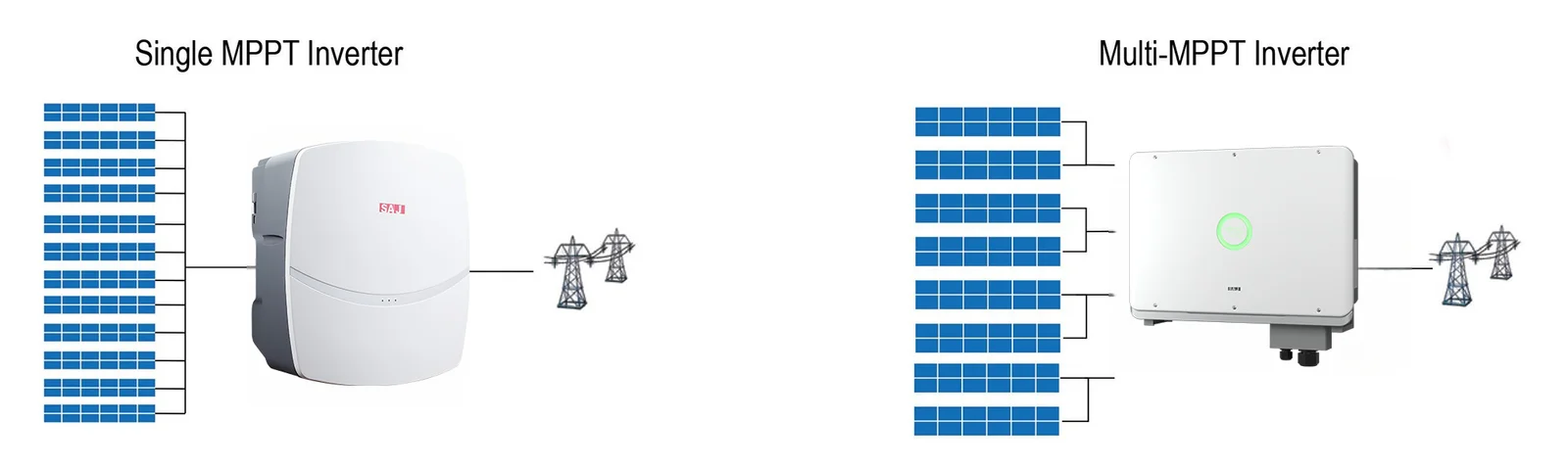
At a Glance: Single-MPPT vs. Multi-MPPT
This table sums up the key differences:
| Característica | Single-MPPT System | Multi-MPPT System |
|---|---|---|
| Best For | Simple, unshaded roofs facing one direction. | Complex roofs with shade or multiple directions. |
| Shade Impact | High. One shaded panel can slow down the whole system. | Low. It isolates the shaded area, so other panels stay fast. |
| Panel Layout | All panel groups (strings) should be identical. | Flexible. Allows for different panel types or group sizes. |
| Total Energy | Lower on complex roofs. | Maximized on complex roofs. |
| Installation | Can be more complex and costly on tricky roofs. | Simpler and cheaper, often needing fewer extra parts. |
Real-World Proof: More Energy and Lower Costs
This isn’t just a theory; it delivers real results.
-
Proven Energy Gains: A study by the famous Fraunhofer Institute in Germany found that for a home with panels on both east and west-facing roofs, using a dual-MPPT inverter produced 3.8% more energy over a year.
-
Simpler, Cheaper Installation: In a large factory project, choosing inverters with multiple MPPTs delivered huge savings. The installers didn’t need to buy 14 extra "combiner boxes" and used 180 meters less copper wire. This alone saved over €3,000 in material costs—not even counting the time saved on labor!
Conclusion:
For any roof that isn’t perfectly simple, a multi-MPPT inverter isn’t a luxury—it’s a necessity. It ensures you get all the power you paid for and can even make your project cheaper and easier to build.
MPPT vs. Reality: Taming Shade and Oversizing
In a perfect world, every solar panel would get full, direct sun all day long. But reality is messy. It has shade, clouds, and complex financial decisions. A modern MPPT’s true test is how it handles these real-world challenges.
Let’s break down how smart MPPTs solve two of the biggest problems: shade e oversizing.
Challenge #1: The Shadow Problem
Even a small shadow from a tree branch or chimney can be a power killer. On a simple system, it can cripple the output of an entire string of panels.
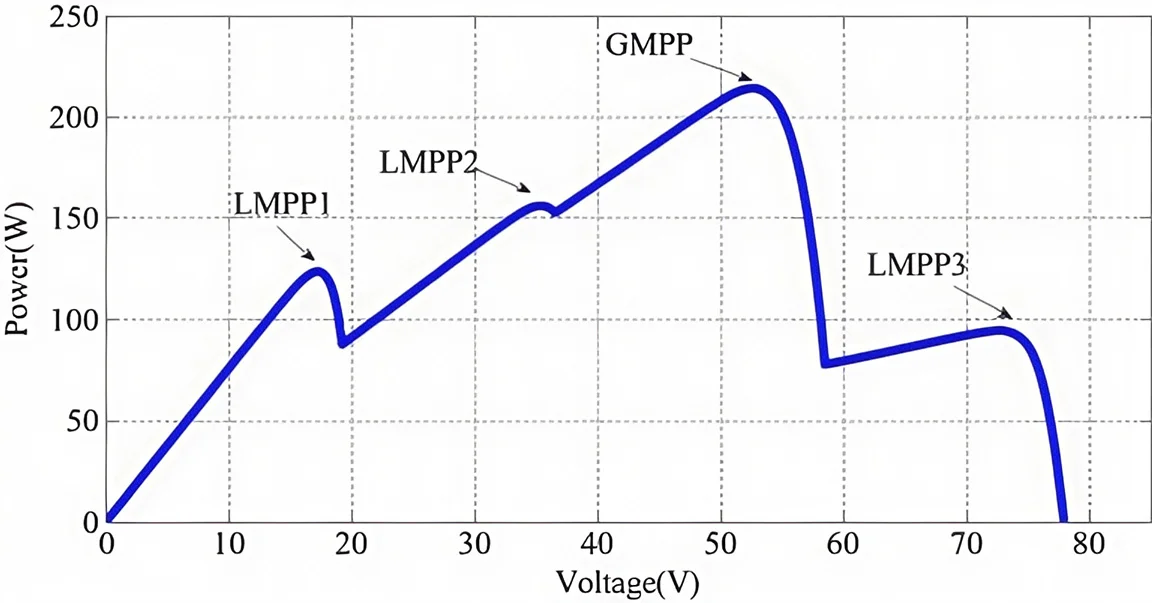
A basic MPPT might see the first small "bump" of power and get stuck there, losing out on the real energy peak hidden by the shade.
How Smart MPPTs Outsmart Shade
Advanced MPPTs act like clever detectives to find the true maximum power point, even when the "crime scene" is complicated by shade. They can achieve over 99% accuracy using two main techniques:
-
Global MPPT Scan
- The MPPT periodically performs a full "sweep" of the panel’s entire voltage range.
- This allows it to "jump out" of any local power peaks caused by shade and find the one, true global power peak.
-
Bypass Diode Coordination
- Solar panels have built-in "detours" called
bypass diodes. When a cell is shaded, these diodes activate to let the energy flow around the blockage. - A smart MPPT understands how these detours change the electrical map and adjusts its strategy accordingly to find the best possible power output.
- Solar panels have built-in "detours" called
Challenge #2: The "Too Much Power" Puzzle (DC Oversizing)
It sounds wrong, but sometimes the smartest move is to install more solar panel capacity than your inverter is rated for. This is called DC Oversizing.
The old way of thinking was: "This is always wasteful because power gets ‘clipped’ and thrown away."
The new reality is that it’s a strategic trade-off.
A study from MDPI showed that even with minor power clipping (~4%) on the sunniest days, a well-oversized system can produce 5% or more extra energy over the entire year.
Why does this work?
- It boosts power during non-peak hours, like early mornings, late evenings, and cloudy days.
- It improves financial returns, as the cost of extra panels is often less than upgrading to a much larger inverter.
This strategy is especially effective with modern inverters built to handle high currents, such as the SAJ R6 e C6 series, which can accept up to 22.5A per MPPT.
Conclusão
Modern MPPT technology is no longer just about finding the sweet spot in perfect conditions. It’s about being a resilient, intelligent problem-solver that maximizes your energy harvest and financial return in the real, messy world.
Decoding Your Inverter: An MPPT Data FAQ
So, your new inverter is online and sending data to an app like SAJ's eSolar Portal. You see a lot of graphs and numbers, but what do they all mean? Here are answers to the most common questions.
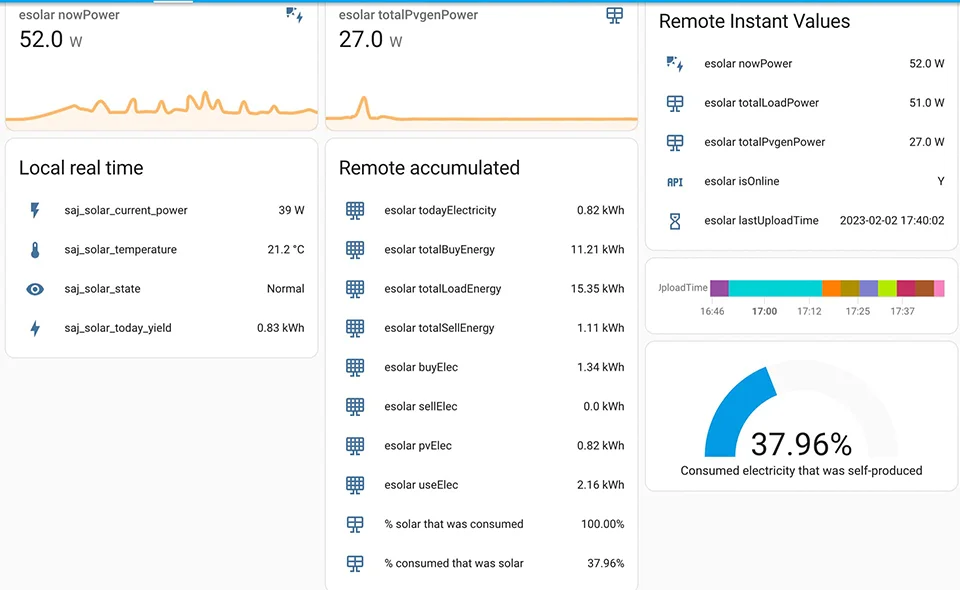
Q1: Do I need to be an expert to understand this?
A: Absolutely not. You only need to know what to look for. The main goal is to spot big differences or unexpected changes.
Think of it like the dashboard in your car. You don’t need to be a mechanic to know that a sudden, new warning light is something you should pay attention to.
Q2: I’m short on time. What’s the single most important thing to check?
A: Consistency. If your system has multiple groups of panels (strings), they should behave like twins on a sunny day.
- Open your app and look at the power output for each MPPT channel.
- Are they roughly the same? Great, your system is likely healthy.
- Is one channel producing significantly less power than the others? That’s your signal to investigate that specific string.
Q3: Okay, I want to dig deeper. What do these acronyms mean?
A: Here are the three key "vitals" for your system’s health:
Vmp(Voltage)- This is the electrical "pressure." It should be fairly stable for your panels under the current weather.
Imp(Current)- This is the electrical "flow." It will change more dramatically with the sun’s intensity.
Power(Watts)- This is the result of
Voltage x Current. It’s your real-time energy harvest.
The key takeaway: A problem often shows up as an unusually low Vmp or Power reading on one string compared to its identical neighbors.
Q4: What should my "Daily Power Curve" graph look like?
A: On a clear, sunny day, it should look like a smooth hill. But there are a few variations:
- The Perfect Hill: A smooth, symmetrical curve. This means a full day of uninterrupted sun.
- Jagged Dips: Sudden, sharp drops in the curve are usually just clouds passing by. Nothing to worry about.
- The Flat Top: If the top of your "hill" looks like it’s been sliced off, this is called "clipping." It’s often a normal and planned part of a system with DC oversizing.
It does not always mean you are wasting power.
Q5: Is there an easier way? Can’t the system just tell me if there’s a problem?
A: Yes, it can. This is where modern cloud intelligence comes in.
The newest monitoring platforms can automatically perform an "I-V Curve Scan," which is like a detailed electrical EKG for your solar array. Using machine learning, this scan can automatically detect and diagnose issues like:
- Panel degradation (
PID) - Hot spots
- Loose wiring
This AI-driven approach can reduce on-site troubleshooting time by as much as 75%, saving you both time and money.
The Energy Dream Team: How MPPT and Batteries Create Synergy
When you add a battery to your solar system, you’re not just adding a box—you’re hiring a sophisticated management team. In hybrid and all-in-one systems, like the SAJ H1/H2 series or the HS2 All-in-One, the MPPT is a crucial player on this team.
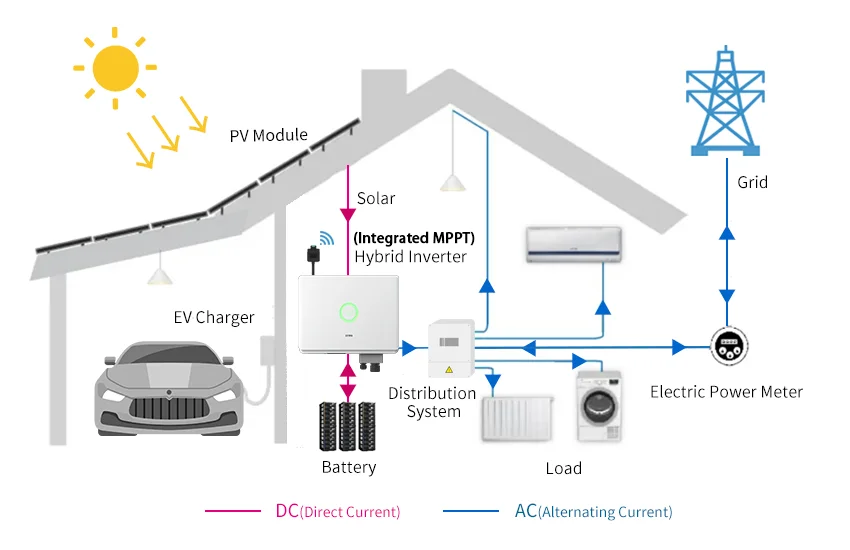
Let’s meet the key players.
Meet the Team: The Brains Behind Your Power
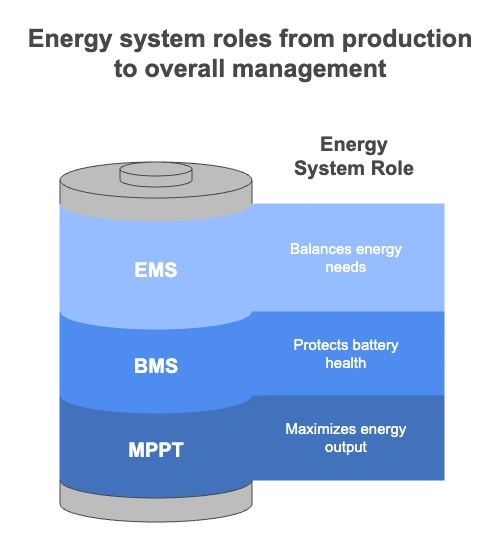
Your hybrid system’s magic comes from these three "players" constantly communicating and working together.
Player 1: The Producer (MPPT)
- Job Title: Chief Energy Officer
- Primary Role: To squeeze every possible drop of energy from the solar panels at all times. It’s the relentless high-performer of the team.
Player 2: The Treasurer (BMS – Battery Management System)
- Job Title: Head of Asset Protection
- Primary Role: To guard the battery. It monitors the battery’s health, temperature, and charge level, ensuring it’s never overworked and lasts as long as possible.
Player 3: The CEO (EMS – Energy Management System)
- Job Title: Chief Executive Officer
- Primary Role: The ultimate decision-maker. It looks at the whole picture—what the Producer is making, what the Treasurer is reporting, what the house needs, and what the grid is doing—and makes the final call.
The Playbook: How the Team Makes Decisions
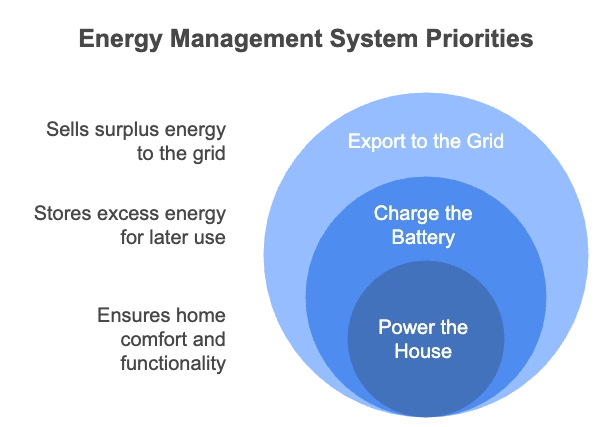
So, how does this team work together? Imagine it’s a sunny afternoon. The MPPT is producing a flood of solar power. The EMS (the CEO) instantly makes a series of decisions, in less than a tenth of a second:
- First Priority: Power the House. Is the air conditioner running? The EMS routes power directly there.
- Second Priority: Charge the Battery. Is the house satisfied? The EMS tells the MPPT to send the excess power to the battery, respecting the
BMS‘s rules for safe charging. - Third Priority: Export to the Grid. Is the house satisfied AND the battery full? The EMS can then decide to sell the remaining power to the grid.
This "smart routing" avoids wasteful energy conversions (DC to AC and back again), boosting overall system efficiency by around 1.5%.
The Winning Strategy: Peak Shaving
This team’s smartest play is saving you money. In areas where electricity costs more during peak hours, the team executes a "peak shaving" strategy:
During the day, they store cheap, abundant solar power in the battery.
In the evening, when grid power is expensive, they use that stored energy instead of buying from the grid.
This single strategy, executed perfectly by the team, can cut peak demand charges by 10-15%, making solar-plus-storage a financial winner.
Wrap-up for MPPT
Let’s distill everything down to one core idea.
A high-quality MPPT isn’t an expense; it’s the single best investment you can make to boost the financial return of your solar project.
It is the engine that maximizes your primary asset: the kilowatt-hours (kWh) your system produces.
Asset Profile: What a "Blue-Chip" MPPT Looks Like
A premium MPPT investment includes a portfolio of modern features. Look for an inverter that offers:
- High Accuracy: The ability to find the true power peak with >99% precision.
- Multiple Inputs: At least two
MPPTchannels for any roof that isn’t perfectly simple. - High Current Capacity: Inputs that can handle the power of new-generation panels (e.g.,
22.5A). - AI-Powered Diagnostics: Cloud-based
I-V Curvescanning to find problems automatically.
Return on Investment (ROI): How Your Investment Pays You Back
Your investment in a superior MPPT delivers returns in three distinct ways:
-
Direct Yield (More Energy)
- It simply harvests more kWh from the same number of panels, directly increasing your energy production and savings.
-
Capital Savings (Lower Costs)
- Smart features like multi-MPPT can reduce the need for extra hardware (like combiner boxes) and wiring, lowering your initial setup cost.
-
Future-Proofing (Long-Term Value)
- It’s the key to unlocking the full potential of battery storage and prepares your home to participate in future energy programs, like Virtual Power Plants (
VPPs).
- It’s the key to unlocking the full potential of battery storage and prepares your home to participate in future energy programs, like Virtual Power Plants (
Investment Strategy: Your Personalized Action Plan
Here is a simple checklist for your specific project type.
Portfolio A: For Grid-Tied Systems (No Battery)
- Plan for DC Oversizing. It’s a proven strategy for higher annual yield.
- Demand Multi-MPPT if your roof has any complexity (shade or multiple angles).
- Verify High-Current Inputs to ensure compatibility with powerful, modern panels.
- Insist on Cloud Diagnostics. It’s your 24/7 system health monitor.
Portfolio B: For Hybrid / Battery Systems
- Choose a True Hybrid Inverter with integrated, intelligent MPPTs.
- Prioritize Smart Power Routing to minimize energy waste.
- Ensure Battery State Awareness for optimal charging and longevity.
Final Verdict
Choosing an inverter is the most critical decision in your solar journey. Don’t just look at the price tag. By investing in superior MPPT technology, you are not just buying a piece of hardware; you are securing a more productive, more resilient, and more valuable energy asset for years to come.
 English
  Deutsch (Österreich)
  Français
  Español
  Português