
 sales@sunriver-electric.com

In 2025, scroll through any solar exhibition feed, and you will see rows of sleek, refrigerator-sized towers. These "All-in-One" systems are marketing stars—clean, cable-free, and futuristic.
Looking at them, you might wonder: Is the traditional, wall-mounted hybrid inverter dead? Is it outdated technology?
It’s a valid question. When Apple launched the iPhone, the separate MP3 player and camera essentially died. Is the same thing happening to energy storage?
As a partner to installers and distributors worldwide, we see the reality on the ground every day. The answer is no. In fact, trying to force the "new tech" into the wrong house is a rookie mistake.
The standalone inversor híbrido is not dead; the market has simply split into two distinct paths: integrated "Home Appliances" for new builds and flexible "Electrical Engineering" solutions for complex retrofits.
Recent data underscores this bifurcation:
The standalone PV inverter segment is projected to expand from USD 5.3 billion in 2025 to USD 18.3 billion by 2035, driven by retrofit demand in aging urban infrastructure. Conversely, integrated All-in-One systems, favored in new residential developments, benefit from a 16.2% CAGR in the broader inverter market through 2032, reflecting mass-market adoption.
This duality ensures both paths remain viable, with U.S. solar installations1 reaching 21 GWac in early 2025 despite policy headwinds.
To make the right buying decision, you don’t need to follow the hype. You need to understand the building.
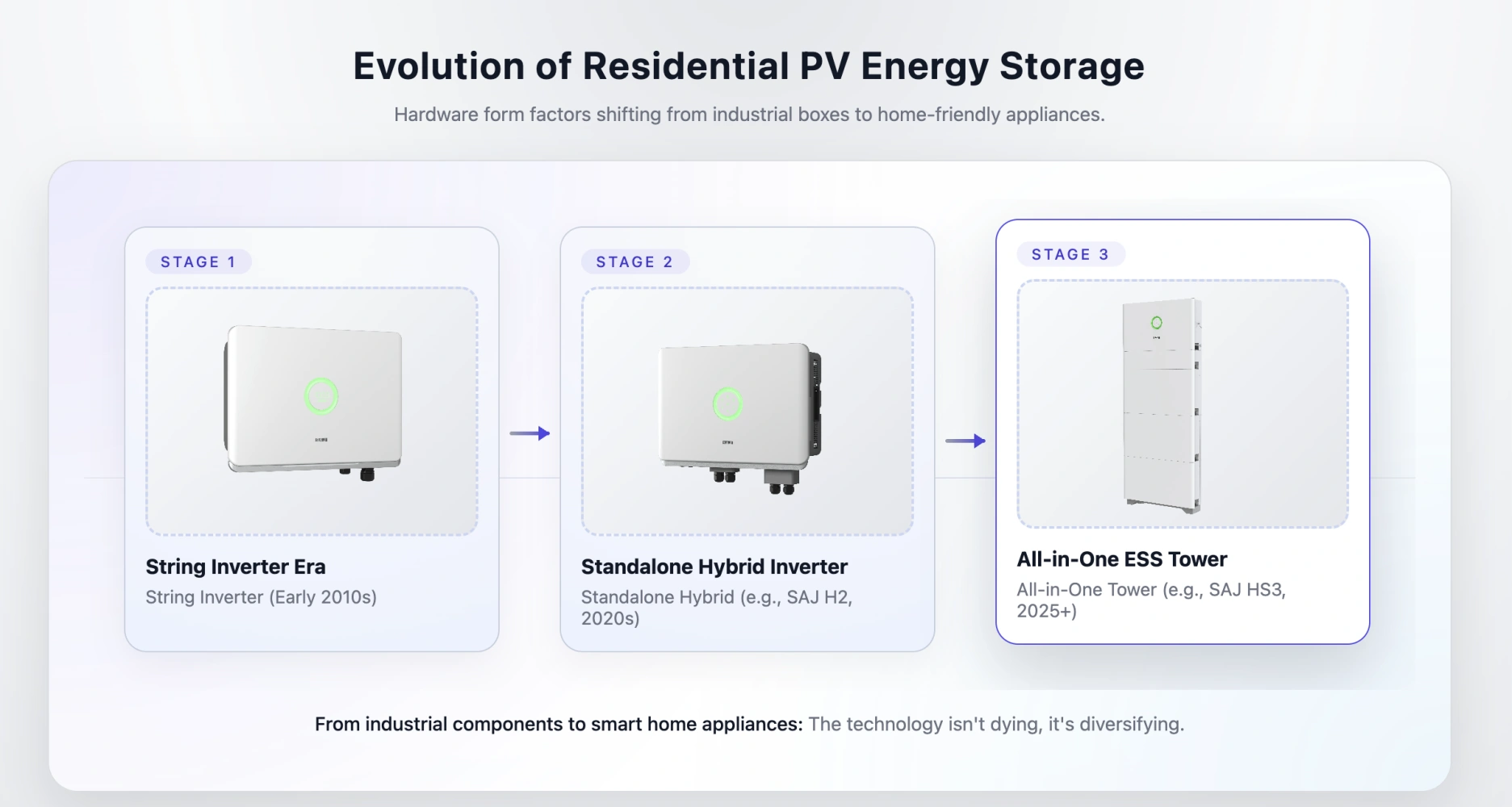
What Are We Actually Comparing: Standalone Hybrid vs All-in-One ESS?
Before we debate which is better, let’s define what we are actually comparing. In the SAJ ecosystem, this is best represented by the H2 Series and the Serie HS3.
The key difference lies in architecture: Standalone inverters separate the power electronics from the battery storage, whereas All-in-One systems integrate the inverter, BMS, and battery modules into a single stack.
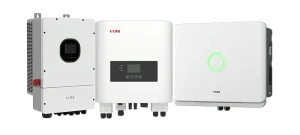
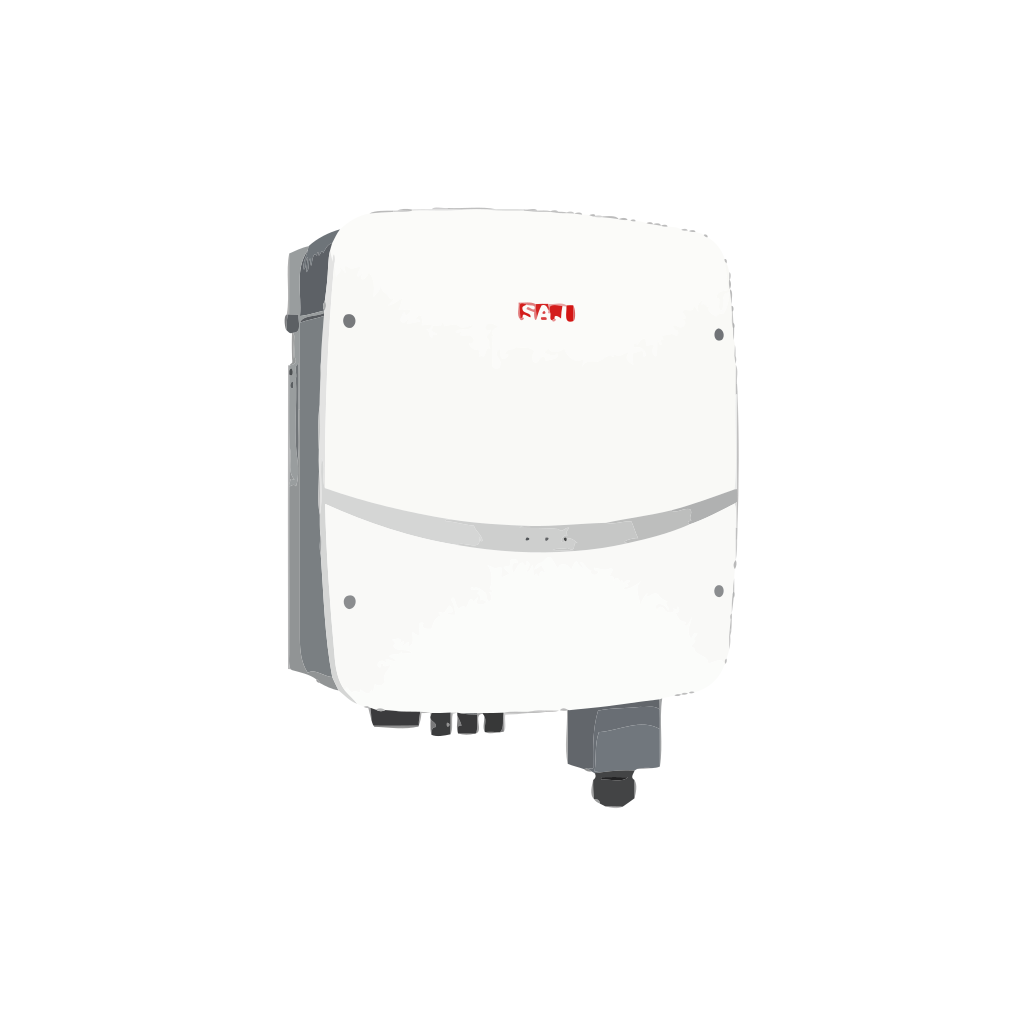
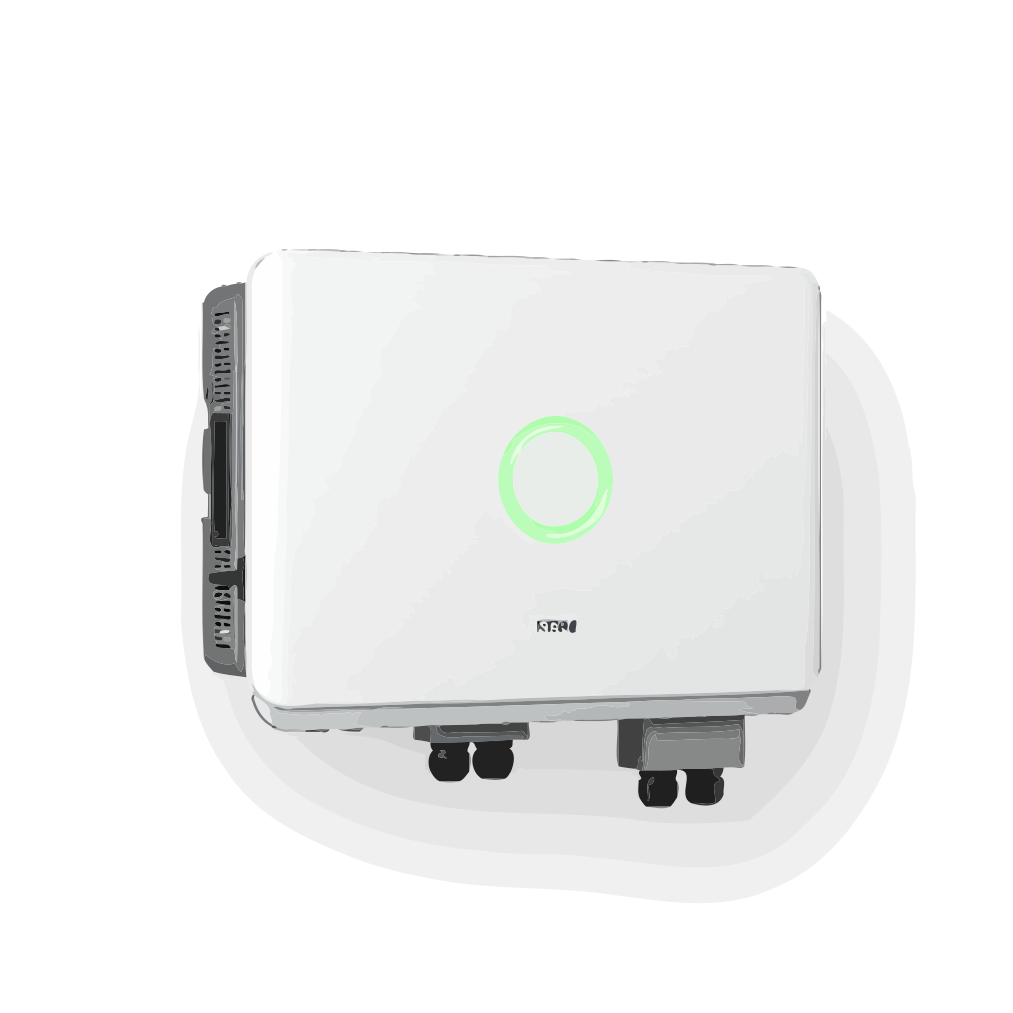
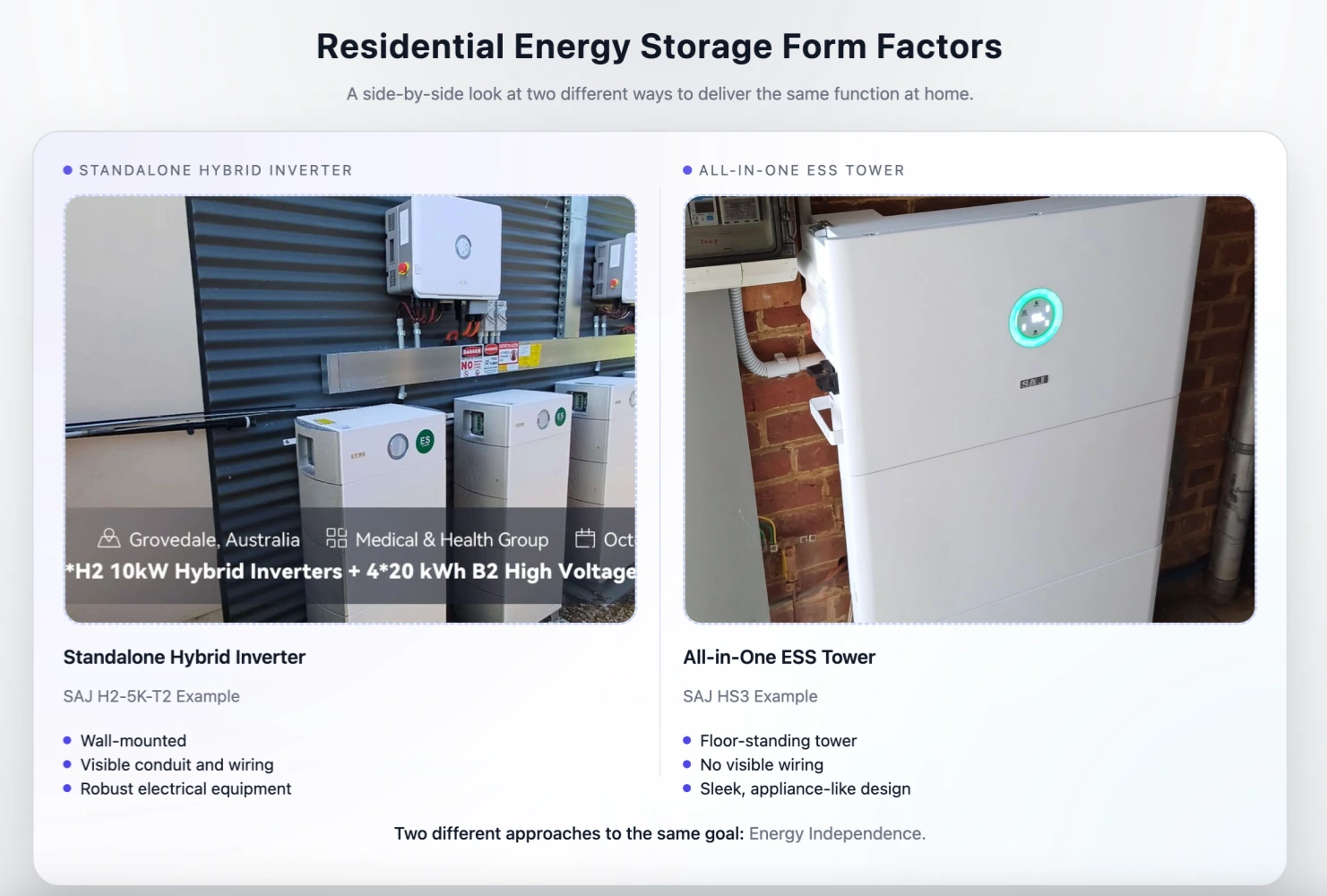
1. The Classic: Standalone Hybrid Inverter (e.g., SAJ H2-5K-T2)
Think of this as the "Router + Modem" setup. It separates the brain (inverter) from the storage (battery).
-
The Vibe: "I am a piece of robust electrical equipment."
-
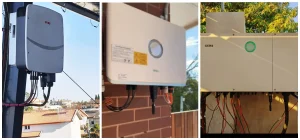
Visuals: Industrial, functional, with visible conduits and wiring.
-
The Insider View: It’s the "Swiss Army Knife"—ugly but fits anywhere.
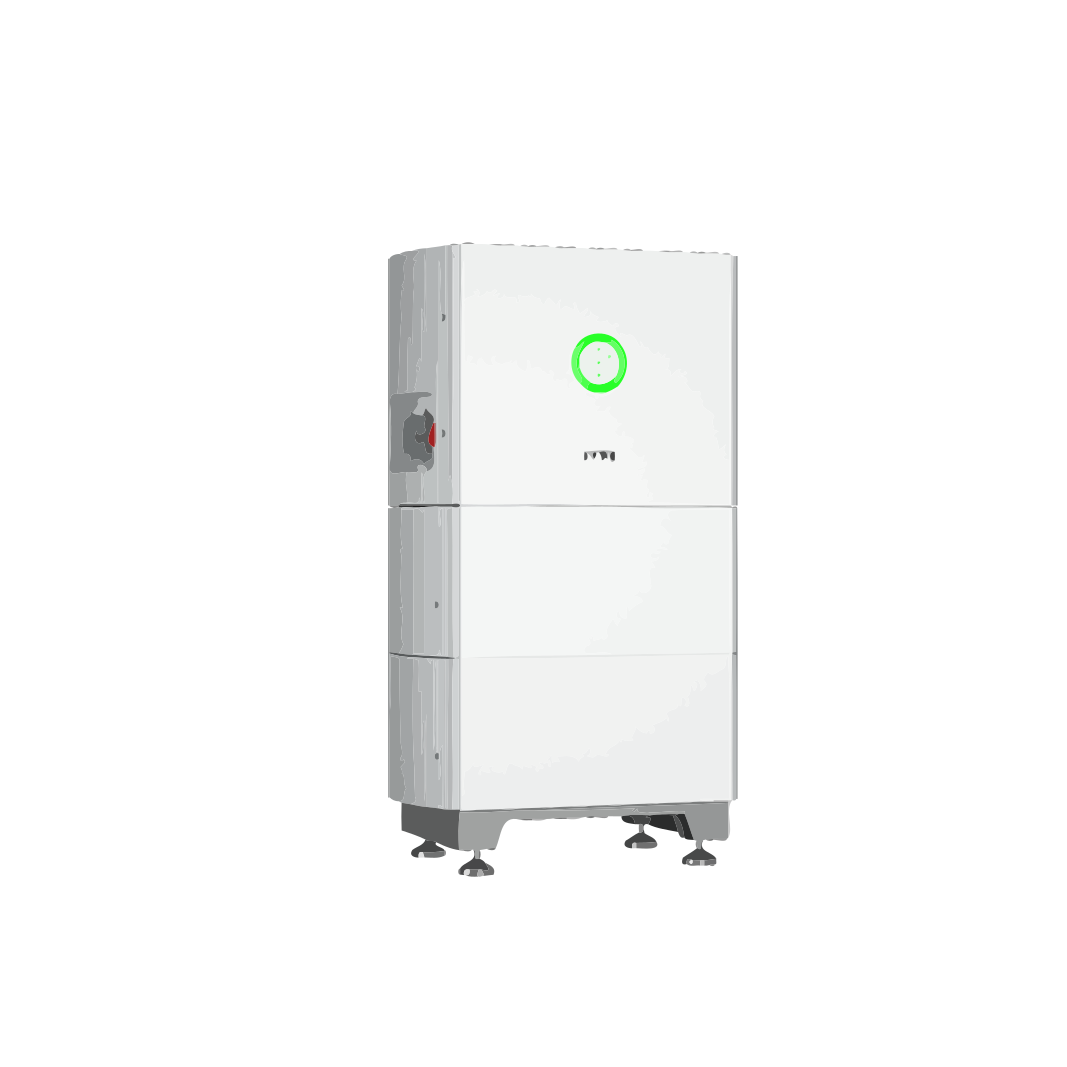
2. The Evolution: All-in-One ESS (e.g., SAJ HS3)
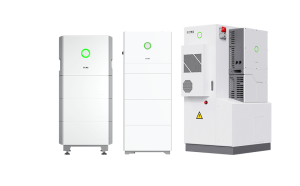
Think of this as the "Smart Home Hub" setup. It unifies the Inverter, Batteries, and BMS into a single stack.
-
The Vibe: "I am a premium home appliance."
-
Visuals: Sleek, furniture-like, with no visible wires (Plug & Play).
-
The Insider View: It’s the "Sports Car"—beautiful and fast, but needs a perfect garage.
Early Context (Basics & Core Concepts)
- Hybrid inverter basics: concept, modes, data – https://sunriver-inverter.com/hybrid-inverter-basics-concept-modes-data/
- Hybrid vs on-grid inverter: in-depth comparison – https://sunriver-inverter.com/hybrid-vs-on-grid-inverter-in-depth-comparison/
- All-in-one energy storage system explained – https://sunriver-inverter.com/all-in-one-energy-storage-system-explain/
Why Does the All-in-One Feel Like the Clear Winner?
If standalone units are still good, why does everyone feel like they are "old news"?
It comes down to a shift in who the customer is. Solar is moving from early adopters (who loved tinkering) to mass-market homeowners (who want simplicity).
All-in-One systems often feel superior because they hide wiring complexity behind a sleek chassis, creating a "visual bias" that favors aesthetics over engineering flexibility.
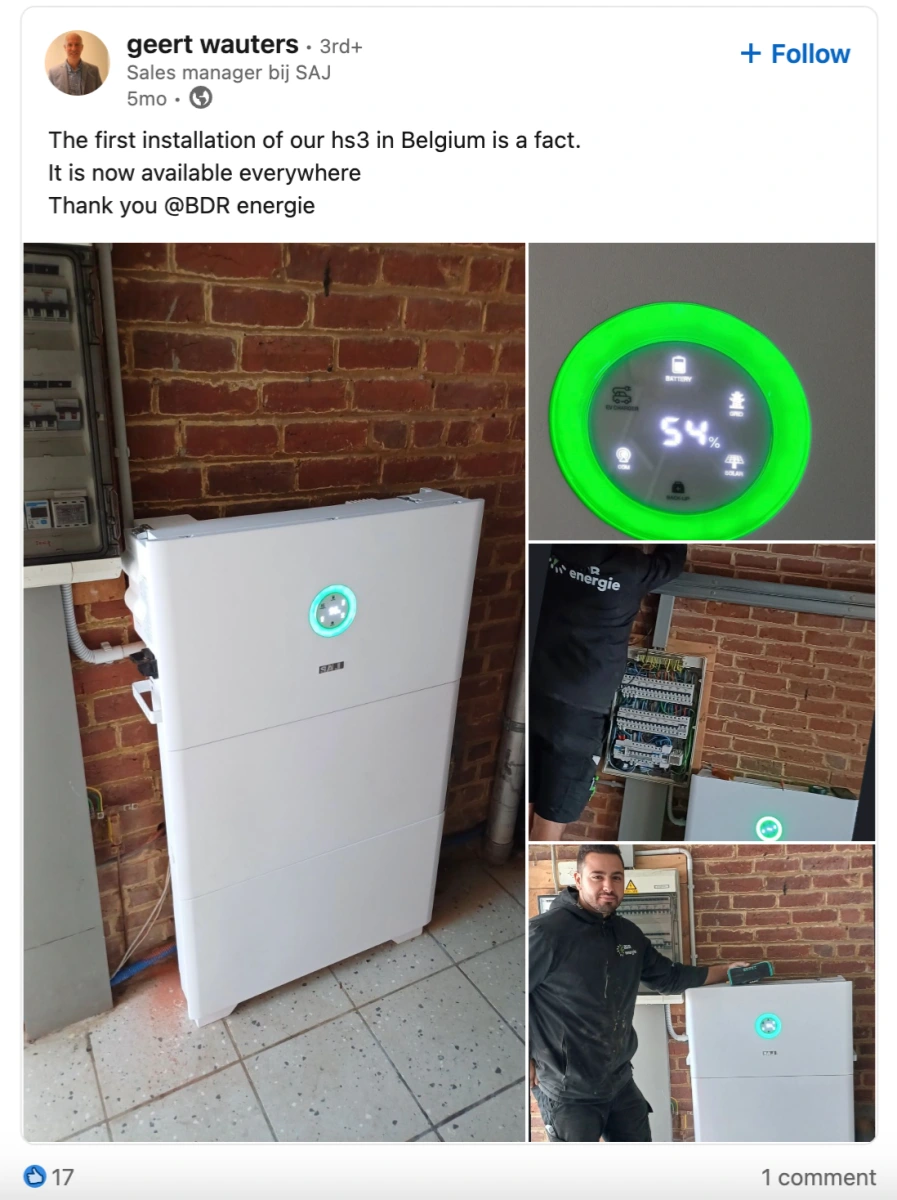
1. The "iPhone Effect" (Visual Bias) We judge technology with our eyes. The HS3 All-in-One looks like a finished consumer product. Homeowners naturally prefer the device that looks good in their garage or hallway.
2. The Invisible Integration In a standalone system, you see the effort. In an All-in-One, all that complexity is hidden inside the shell. It feels more advanced because the mess is invisible.
3. The "Instagram vs. Reality" Trap Installers love to post photos of their neatest All-in-One towers. What they don’t post is the 4 hours they spent rerouting the entire main switchboard just to make that tower fit in that specific corner. This creates a perception that "towers are easy," hiding the complex prep work often required behind the scenes.
⚡ FAQ – Tech & Safety Basics
(Common questions we get asked that apply to ANY system)
Why Is the Standalone Inverter Still the Industry Backbone?
Despite the beauty of the All-in-One, the standalone hybrid inverter (like the H2) remains the workhorse of the industry. Why? Because real-world houses are messy.
Standalone hybrid inverters remain the industry backbone because they offer superior placement flexibility and are often the only viable option for complex retrofit projects where space is constrained.
1. The "Retrofit" Nightmare Saver Let’s be real: trying to retrofit a sleek All-in-One tower into an existing solar home can be a headache. You might have to rewire AC runs across the house to a new location. A standalone inverter (H2) respects the existing mess. It can replace the old unit on the wall, reusing existing conduit, while the batteries get tucked away wherever they fit. It saves you from drilling unnecessary holes in a client’s wall.
Case Study: Urban Retrofit Triumph
In a 2025 Brooklyn brownstone upgrade, installers faced constrained wiring paths in a pre-1950s structure. Opting for the SAJ H2-5K-T2 allowed seamless integration with existing conduits, relocating batteries to a sub-basement while mounting the inverter externally—reducing labor by 25% versus an All-in-One retrofit.
The result: Full energy independence without aesthetic disruption, yielding a 12% ROI in Year 1. As one installer noted, "H2 turned a potential nightmare into a quick win."
For new-build contrast, a Florida eco-home used HS3 for plug-and-play efficiency, cutting install time to under 4 hours.
2. The "Happy Wife, Happy Life" Factor (Noise & Heat) All power electronics make a slight hum and generate heat.
- The H2 Trick: Mount the noisy, hot inverter on an exterior wall. Put the silent, temperature-sensitive battery in the cool basement.
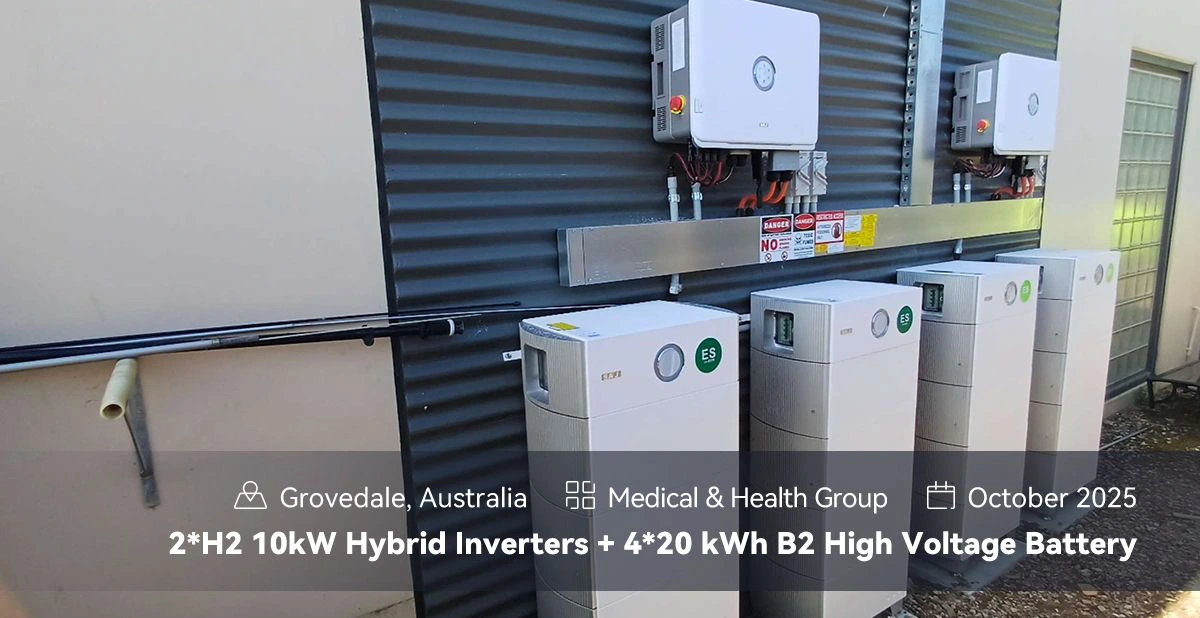
- The Result: The equipment runs happier, and the homeowner never hears a fan whirring in their hallway. You can’t separate the components like this with a tower.
3. The "Mix and Match" Freedom The H2 series is a "universal adapter" with a wide voltage window (180–600V). If a specific battery brand is out of stock or discontinued in 5 years, the H2 gives you options. You aren’t locked into a single proprietary ecosystem forever.
Who Actually Wins the Numbers Game: H2 or HS3?
Let’s look at the numbers. Is the new tech strictly better, or just different?
While the HS3 All-in-One wins on efficiency with 200% oversizing for low-light conditions, the H2 standalone inverter wins on compatibility with its wider 180–600V battery voltage range.
| Característica | Standalone (H2-5K-T2) | All-in-One (HS3-5K) | The Takeaway |
|---|---|---|---|
| Philosophy | Flexibility First | Integration First | One adapts to the site; one streamlines the site. |
| Max DC/AC Ratio | 150% | Up to 200% | HS3 wins on efficiency. 200% allows for massive solar harvesting in low light. H2’s 150% is the standard "Goldilocks" zone for most roofs. |
| Battery Voltage | 180V – 600V | 380V – 500V | H2 wins on compatibility. It accepts a wider range of battery strings. HS3 is optimized strictly for its own stack. |
| Instalación | Screw Terminals | Floating Plugs | HS3 wins on speed. Stackable modules reduce labor time and wiring errors. H2 requires traditional electrical work. |
| The Real Headache | Visible Wires | Site Prep | H2 looks messy if cable management is bad. HS3 is a nightmare if the floor isn’t perfectly level or the wall isn’t straight. |
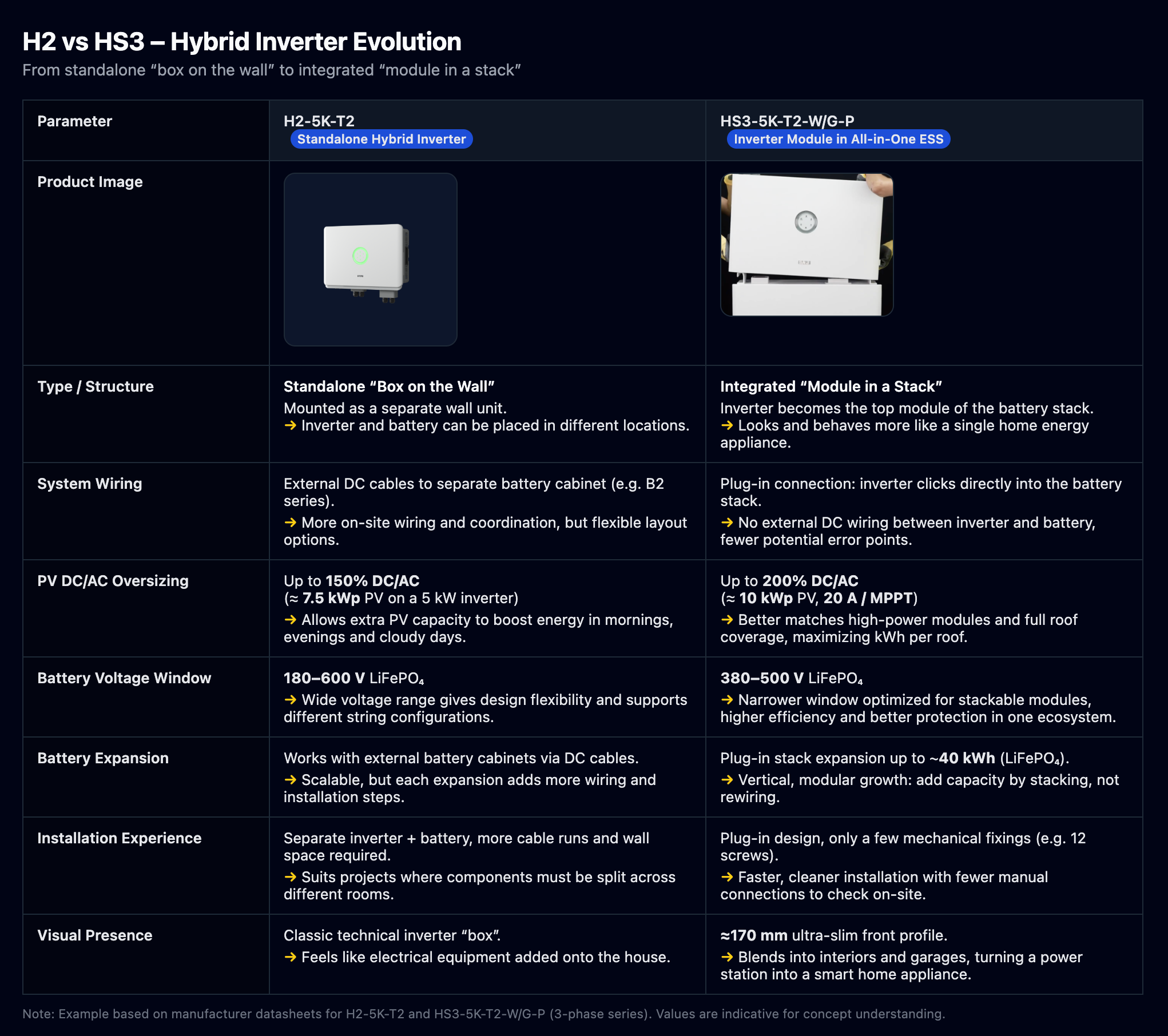
Deep Dive: What do these numbers mean for you?
Why does 200% Oversizing (HS3) matter? It’s not about peak summer days (where energy is clipped anyway). It’s about Winter y Cloudy Days. With 200% oversizing, you can install double the solar panels relative to the inverter size. This ensures that even on a gray December afternoon, you are generating enough power to charge your battery. The HS3 is built for this "energy independence" mindset.
Why does Wide Voltage (H2) matter? It’s about Supply Chain Freedom. A wider voltage window (180-600V) means the inverter isn’t picky. As a distributor or installer, if your preferred battery brand is out of stock, the H2 gives you options to switch to another compatible high-voltage battery without changing the inverter.
💰 FAQ – Outages & Upgrades
(Common questions about living with the system)
So, Which System Is Right for Your Project?
As a partner to SAJ, Sunriver Electric suggests a simple rule: Don’t choose based on hype. Choose based on the building.
Choose the standalone H2 for retrofits and complex sites where components need to be separated, but select the All-in-One HS3 for new builds where aesthetics and installation speed are the priority.
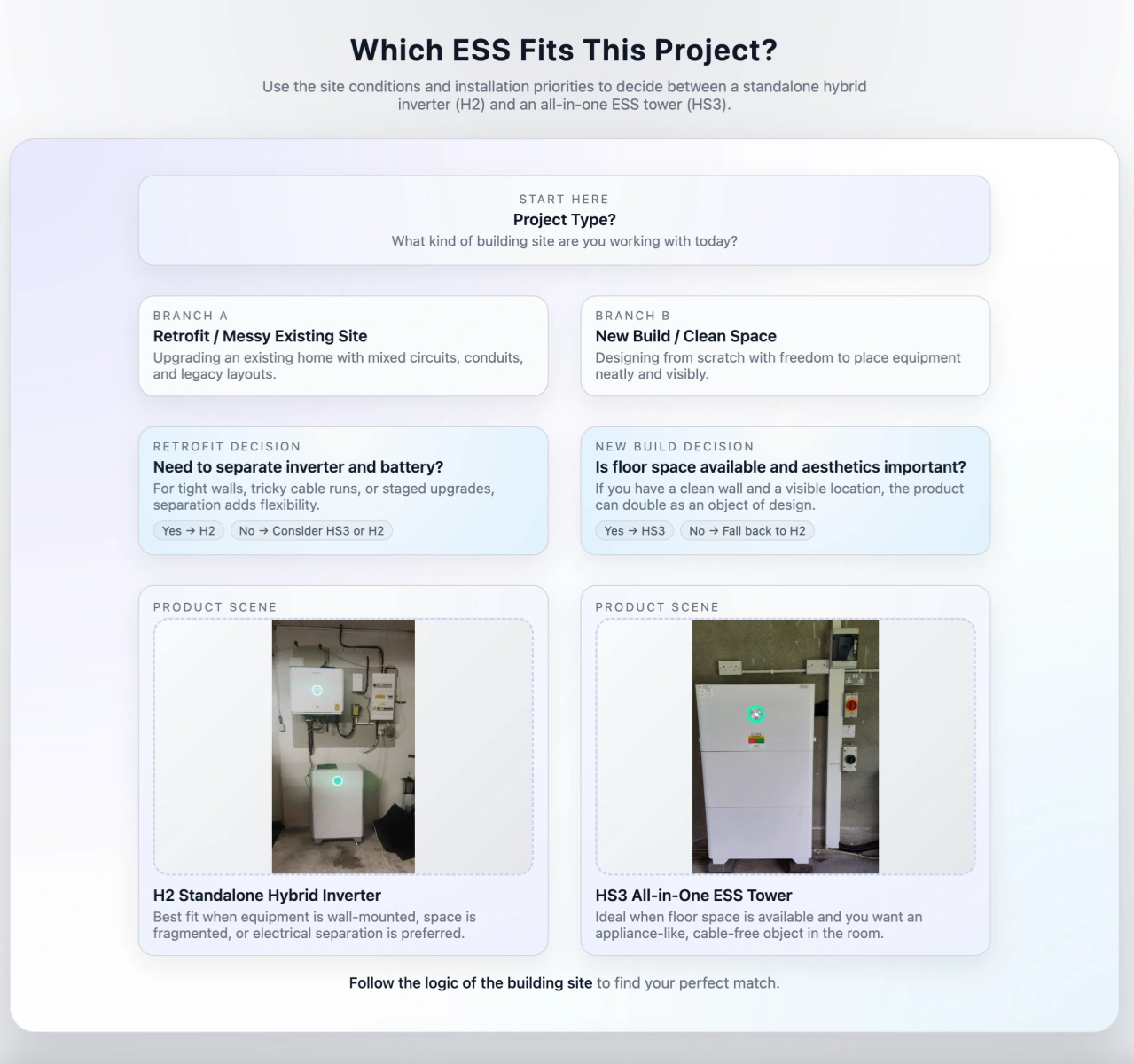
Use the Standalone (H2) if:
- [ ] It’s a Retrofit: You are upgrading an existing system and don’t want to rewire the whole house.
- [ ] Space is Split: You need to keep the noise outside (inverter) and the chemistry inside (battery).
- [ ] Wall > Floor: You have crowded floors but empty walls.
- [ ] Budget Strategy: You want to save on hardware costs (standalone is often slightly cheaper upfront) and don’t mind slightly higher labor complexity.
Use the All-in-One (HS3) if:
- [ ] It’s a New Build: You are designing a modern home and have dedicated floor space.
- [ ] Aesthetics Matter: The unit will be visible (e.g., inside a hallway or open garage) and needs to look good.
- [ ] Speed Strategy: You want to save on labor costs. The "stack and click" installation is significantly faster than wiring separate boxes.
- [ ] Performance is Key: You want to maximize low-light generation with 200% oversizing.
Decision Stage (All-in-One & Buying Guidance)
- HS3 energy storage system review – https://sunriver-inverter.com/hs3-energy-storage-system-review/
- All-in-one energy storage system comparison – https://sunriver-inverter.com/all-in-one-energy-storage-system-comparison/
- Best all-in-one home energy storage 2025 – https://sunriver-inverter.com/best-all-in-one-home-energy-storage-2025/
Glimpse Ahead: 2025 and Beyond
As cybersecurity and overcapacity pressures mount— with global inverter revenue rising 8% in 2025—hybrid evolution will blend standalone flexibility with All-in-One smarts via modular AI interfaces.
Expect H2-compatible firmware updates for 200% oversizing parity and HS3 expansions for EV integration. Installers who master this hybrid landscape will lead the charge toward resilient, 24/7 energy independence.
Final Thoughts
The hybrid inverter isn’t dead. It just got a promotion.
In the HS3, the inverter has graduated to become the brain of a smart home appliance. In the H2, the inverter remains the rugged engine of the electrical grid.
Both are excellent. Both are SAJ. The best one is simply the one that fits your wall.
-
Stay updated with the latest statistics on solar installations in the U.S. and their growth trends. ↩